

You likely remember when searching meant scrolling through pages of blue links to find what you needed. That environment has changed as people now talk directly to AI systems that provide immediate responses. Instead of visiting ten different websites, your audience gets a single summary that answers their question without a single click.
This change has caused a massive drop in organic traffic for many websites that relied on traditional methods. Reports show that traditional search volume is falling as users prefer the speed of AI responses. If you want your business to stay relevant, you must adapt your strategy to account for this loss of direct clicks.
Your primary goal is no longer just ranking at the top of a list to get a click. You now work to become the specific source that the AI mentions when it gives an answer. Winning the citation means you are the trusted voice that the machine trusts to represent the truth to the end user.
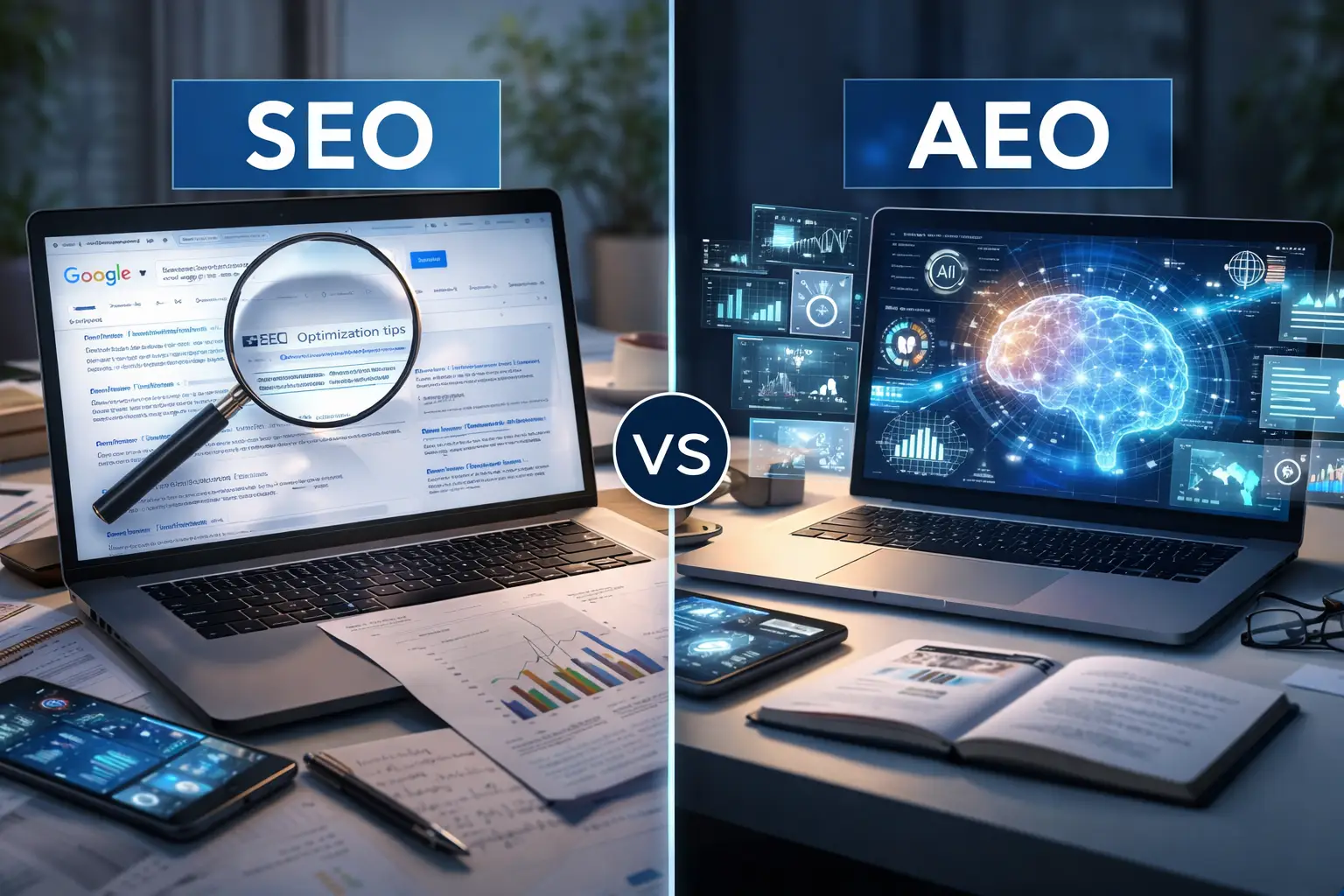
What is the Difference Between SEO and AEO?
Traditional SEO focuses on helping webpages rank in search engine results. It relies on elements such as keywords, backlinks, and technical optimization so search engines can understand and index your pages correctly. The goal is to place your website among the top results when users search for specific queries.
Answer Engine Optimization (AEO) takes a different approach. Instead of simply ranking pages, AEO focuses on structuring content so AI systems and answer engines can directly extract and present information to users. This includes voice assistants, AI search tools, and generative platforms that summarize information rather than displaying a list of links.
In practical terms, SEO helps users find your page, while AEO helps AI systems use your content to answer questions. Content written with clear explanations, structured headings, factual statements, and direct answers is more likely to be selected by AI systems when generating responses.
Creating Optimized Content for AI Platforms
Preparing your pages for machine consumption requires a change in how you organize information. Below are the methods you can use to ensure AI models select your content as their primary source.
The “Quick-Response” 50-Word Summary
You should place a short summary of about fifty words immediately after your main headings. This block of text acts as a clear signal to AI crawlers that you have a direct answer ready for extraction. By providing a concise statement, you make it easy for a machine to identify the core message of your section.
This practice helps you match the way large language models scan for information. They look for high-density facts that can be repeated to a user in a conversational way. A well-placed summary ensures your content is the first thing the system finds when searching for a response to a specific query.
You want to avoid using complex language or unnecessary descriptors in this section. The concentration remains on clarity so the AI can pull the text without needing to rewrite it. Keeping this block simple increases the chances that your brand becomes the official citation for that topic.
The Wikipedia-Style Definition Framework
Starting your articles with a declarative sentence that defines the topic is essential for authority. You want to use a structure where “X is Y” to provide an immediate anchor for the machine. This helps the AI categorize your page within its knowledge graph quickly and accurately.
When you establish this foundation early, the machine views your page as a primary definition source. It reduces the work the AI has to do to understand the context of your writing. Clear definitions are highly favored by models that need to explain complex topics to users in seconds.
This method also helps you avoid the ambiguity that often confuses AI agents. By being direct from the first sentence, you tell the crawler exactly what the page is about. This clarity is a major factor in whether a model decides to trust your data over a competitor.
Transitioning to Conversational Question Headings
You should change your headings from short fragments to natural language questions. Instead of using a heading like “AEO Benefits,” you should use “What are the benefits of AEO for my business?” This matches the way people actually speak to their AI assistants and devices.
This phrasing helps the AI match your content to the logic of a user’s query. When the heading matches the question being asked, the machine sees your content as the most relevant answer. It creates a direct link between the user’s intent and your provided information.
Using questions as headings also allows you to address the long-tail queries that AI engines often handle. These systems break down large questions into smaller parts to provide a complete answer. Having questions as your structure makes your content easier to parse for these complex response patterns.
Reducing Cognitive Load for Machine Reading
Writing in short sentences that stay under twenty words is now a requirement for high rankings. Machines can parse simple sentences much faster than long, winding thoughts. When you reduce the difficulty of reading, you increase the likelihood of the AI selecting your text.
Simple structures prevent the AI from misinterpreting your meaning. You want to ensure that every sentence carries one clear idea without unnecessary additions. This makes your content more reliable when the AI is trying to summarize your points for a user.
A machine is less likely to cite a page that it finds confusing or difficult to process. By keeping your writing clear and direct, you are making it “easy” for the AI to do its job. This preference for simplicity is a core part of how answer engines function today.
Utilizing Data Tables for Structured Extraction
AI agents prefer information that is organized into tables because it is easy to compare and extract. If you have pricing, statistics, or feature lists, you should always present them in a tabular format. This allows the machine to pull specific data points without having to read through paragraphs of text.
Tables provide a high level of structure that machines can understand with high confidence. When an AI needs to answer a question about “how much something costs” or “what the top features are,” it looks for structured data first. Your table can become the direct source for an AI comparison tool.
You should ensure your table headers are descriptive and clear. This helps the machine understand exactly what each row and column represents. The more structured your data is, the more useful it becomes to an answer engine that needs to provide quick facts.
Eliminating Narrative Fluff
In 2026, the standard for content is a high information-to-word ratio. You should remove any sentences that do not add new data or context to the reader. Filler content that used to help with keyword density now hurts your ability to be cited by AI.
Answer engines are designed to be efficient, and they ignore fluff when generating responses. If your page is filled with unnecessary introductions and repetitive phrases, the machine may view it as low quality. You want every word to serve a purpose in providing a factual answer.
Content that is straight to the point performs better because it respects the user’s time and the machine’s processing power. By cutting out the narrative noise, you make your facts stand out. This professional and direct tone is what AI models are trained to look for in authoritative sources.
Technical Architecture for the AI-First Web
Your website needs a clean data feed specifically for crawlers by including an llms.txt file in your root directory. This file acts as a simplified version of your site that allows AI models to train or retrieve data without getting lost in your layout code. It is the modern version of a sitemap, but it is built for the logic of a machine rather than a search index.
You also need to update your robots.txt to manage how specific AI agents interact with your pages. You can choose to allow or restrict bots like PerplexityBot or OAI-SearchBot depending on your data strategy. Managing these permissions ensures that your most valuable information is being read by the engines that drive the most traffic.
Speed is more important than ever because AI assistants that crawl the web in real-time will not wait for slow pages. If your server takes more than a second to respond, the AI will move to a faster competitor to get the answer it needs. Sub-second response times are the baseline for being included in live AI overviews.
Implementing Advanced Schema for AI Reasoning
Standard markup is no longer enough to help an AI understand the depth of your information. Below are the specific types of schema you should use to give your data the best chance of being selected.
Beyond Basic Article Schema
You need to use granular JSON-LD to define exactly what your content is trying to accomplish. Instead of just labeling something as an article, you should specify if it is a review, an analysis, or a news report. This extra layer of detail helps the AI categorize your information within its internal reasoning system.
Providing this context allows the machine to understand the intent behind your writing. When the AI knows you are providing a professional analysis, it can cite you for queries that require expert opinions. It moves your content from being just “text” to being a specific type of “knowledge.”
This level of detail also helps with how your brand is represented in the AI’s memory. The more specific you are with your schema, the less likely the machine is to make a mistake about your identity. It creates a clear path for the crawler to follow when it needs to verify your claims.
FAQPage Schema for Instant Answer Mapping
Connecting your on-page questions directly to the code layer allows AI engines to map answers instantly. When you use FAQ schema, you are essentially giving the AI a list of ready-made responses. This is one of the most useful ways to appear in featured summaries and AI overviews.
The AI does not have to guess what the answer is when you provide it clearly in the code. It can pull the question and the response directly from your JSON-LD and present it to the user. This increases your reach because your content is being used in its original form.
This method also ensures that your brand is credited for the answer. Since the data is pulled from your specific schema, the citation link is more likely to point back to your page. It is a simple way to build authority in your specific niche.
HowTo Schema for Sequential Logic
Helping AI engines understand step-by-step processes is necessary for any instructional query. When you use HowTo schema, you are breaking down a complex task into a logical sequence that a machine can follow. This is vital for appearing in “how-to” responses and voice assistant instructions.
The machine uses this schema to guide users through a process without them having to read the whole page. Each step is treated as a separate data point that the AI can read aloud or display in a list. This makes your content the preferred source for anyone looking for a solution to a problem.
By organizing your logic this way, you also show the AI that your content is well-researched and structured. Sequential logic is a sign of high quality that machines value when looking for reliable information. It helps you become the go-to resource for practical advice in your industry.
Organization and SameAs Entities
Linking your site to verified entities like LinkedIn or official brand profiles creates a web of trust. You want the AI to see that your website is part of a larger, verified existence on the internet. Using the Organization schema with SameAs properties helps the machine connect the dots between your site and your official social presence.
This consistency helps the AI verify that you are who you say you are. If the information on your site matches your LinkedIn and your Crunchbase, the machine’s confidence in your data increases. This trust is a major ranking signal in the 2026 environment.
Without these entity links, the AI might treat your site as an isolated source with no history. Linking to recognized platforms gives your brand a history and a reputation that the machine can track. It is the digital equivalent of showing your credentials before giving an answer.
FactCheck and ClaimReview Schema
Signaling that your data points have been verified is a requirement for high-trust niches like finance or health. Using FactCheck and ClaimReview schema tells the AI that you have gone through the effort of checking your facts. This makes your content much more likely to be used in AI overviews where accuracy is the top priority.
Answer engines are increasingly cautious about spreading misinformation, so they look for these verification signals. When you explicitly state that a claim has been checked, you provide the machine with a “safety” signal. This can help you outrank sites that may have more traffic but less transparency.
This also protects your brand from being misrepresented by an AI. When you provide the claim and the evidence in the schema, the machine is less likely to hallucinate or change your meaning. It gives you more control over the factual narrative of your content.
The New Authority: E-E-A-T 2.0 in the Age of AI
Your brand’s story must be identical across every platform for an AI to trust you. This entity consistency means that your founder’s bio, your mission statement, and your product details should not change from one site to another. If the machine finds conflicting information, it will lower your authority score and look for a more reliable source.
To be cited, you must provide unique value that the model cannot find elsewhere, which is known as information gain. If your article is just a rewrite of existing top results, the AI has no reason to mention you. You need proprietary data, original research, or a unique perspective to become an un-ignorable source for the machine.
Freshness has become a critical signal, and many experts now follow a thirteen-week update rule. Content that has not been touched in three months is often viewed as outdated by AI training sets and real-time retrievers. Keeping your statistics current and your timestamps visible shows the machine that your data is still the most accurate choice for a user.
Local SEO: Optimizing for Hyper-Local AI Answers
Answer engines handle local queries by looking for specific markers that connect your business to a physical area. If a user asks for a service “near me,” the AI scans for localized entities that confirm your location. You must ensure your city, neighborhood, and service area are clearly mentioned in your content and your metadata.
Third-party verification from sites like Google Maps, Yelp, and G2 is more important than ever for local AEO. The AI cross-references your site with these platforms to ensure your business is active and trusted by the local community. If you have high ratings on external sites, the AI is more likely to recommend you in a conversational response.
Appearing in the local pack of an AI overview requires a mix of structured data and local relevance. You should create content that mentions local landmarks, events, or community news to ground your brand in that specific area. This tells the machine that you are not just a general website, but a local authority that can solve the user’s immediate problem.
Platform-Specific Optimization: Ranking in AI Search
Every AI platform has its own way of selecting sources and providing answers. Below are the specific methods you should use to ensure you are being seen across all the major players in the market.
Strategies for Perplexity AI Citations
Perplexity favors academic-level sourcing and content that provides deep-link references. If you want to be cited here, your writing should be backed by clear data and external links to reputable studies. The system looks for pages that function as comprehensive references rather than simple blog posts.
You should aim for a professional tone that avoids hype or marketing language. Perplexity users are often looking for facts and research, so your content should reflect that intent. Including a bibliography or a list of sources at the end of your page can also help the engine recognize your authority.
The engine also tracks how long users spend reading your cited sections. If people find your answer useful and stay on the page, the AI will continue to use you as a primary source. High engagement combined with factual depth is the winning formula for this specific platform.
Optimizing for Google AI Overviews (SGE)
Google’s AI overviews are still heavily connected to traditional search rankings. There is a strong correlation between being in the top five organic results and being the featured citation in the AI summary. This means your core SEO foundations like site structure and brand authority are still vital.
You should focus on becoming a recognized authority for specific topics. Google favors brands that show a deep understanding of a subject across many different pages. Building clusters of content that all point to a main pillar page helps the AI see you as an expert in that area.
The AI overview also pulls heavily from your schema and your on-page headings. By following the “question and answer” structure mentioned earlier, you give Google the exact blocks it needs to build a summary. Being direct and using high-quality images can also increase your chances of being featured.
ChatGPT Search and Bing Integration
ChatGPT search relies heavily on the Bing index and how it handles real-time query expansion. To rank here, you must ensure that your site is fully indexed by Bing and that you are not blocking OpenAI’s crawlers. The system looks for publishers that provide real-time updates and clear answers to conversational queries.
This platform often expands a single user question into multiple sub-queries to find the best answer. You should ensure your content covers a topic from multiple angles to capture these expanded searches. Providing a comprehensive view of a subject makes your page a more valuable resource for the model.
ChatGPT also favors content that is easy to summarize in a friendly, conversational tone. While the facts must be accurate, the way you present them should be accessible to a general audience. Balancing technical accuracy with simple language is the key to succeeding in this environment.
Meta AI and Social Signal Influence
Meta AI uses a mix of web data and social proof to generate its answers. Community engagement on platforms like Instagram and Facebook can influence how the AI perceives your brand’s relevance. If people are talking about your products or services on social media, the AI is more likely to suggest you to a user.
You should encourage reviews and discussions around your brand to build this social authority. The machine looks for signals that you are a trusted name in your industry based on how people interact with you. This makes social media a key part of your AEO strategy.
Meta’s system also favors visual content and short, punchy information. Since many users interact with Meta AI through mobile apps, your content should be optimized for quick reading. Having a strong social presence that mirrors your website’s information helps the AI verify your brand.
Claude and Gemini: Contextual Depth
These models favor long-form content that shows a clear logical flow and nuanced understanding. Unlike some of the faster engines, Claude and Gemini are often used for complex research and deep thinking. Your content should provide detailed explanations and cover the “why” behind the “what.”
You should use a structure that builds a logical argument from one paragraph to the next. These models are very good at following a narrative, so ensuring your points are connected is vital. They look for high-quality writing that provides a complete picture of a topic.
Claude and Gemini also appreciate content that acknowledges different viewpoints or adds nuance to a simple answer. By providing a balanced view, you show the AI that your content is objective and trustworthy. This level of depth is what makes these models select your page for high-level queries.
How to Rank in AI Search: A Practical Workflow
You should start by auditing your existing content to see if it meets the new standards for machine readability. This involves looking at your headings, checking your sentence length, and ensuring your answers are easy to find. Any article that was written before 2025 likely needs an update to be competitive in the AEO space.
There are now tools that can test how easily an AI can extract information from your page. You should use these to find areas where your writing is too complex or where your structure is breaking down. Testing your “machine readability” score is just as important as checking your keyword density used to be.
The final step is to include proprietary research that makes your site a source that cannot be ignored. When you have data that no one else has, the AI must cite you if it wants to be accurate. This is the most useful way to secure your share of model and stay ahead of the competition.
Measuring Success: New KPIs for the AEO Landscape
Tracking how often your brand is the primary source in AI summaries is now a core metric called Citation Share. You want to see your name appearing as the “source” link for the topics that matter most to your business. This shows that the AI models view you as the top authority in your field.
You should also measure assisted conversions, which tracks users who found you through an AI citation before visiting your site. Even if they didn’t click the first time, seeing your brand name in an AI answer builds trust. This traffic often has a higher intent because the user has already been given a preview of your expertise.
Zero-click brand recall is a new way to assess your awareness by looking at the sentiment of AI mentions. You can use tools to see how AI engines describe your brand to users when you aren’t being directly cited. If the machine consistently describes you in a positive and accurate way, your AEO strategy is working.
Final Word: Staying Ahead of the Algorithm
The movement from keyword ranking to factual citation is a major change in how we think about the internet. You must move away from the idea of “gaming” a search engine and move toward being a high-quality data source. Those who provide the best answers in the best format will be the ones who win the most reach.
Balancing human-centric storytelling with a structure that machines can read is the key to long-term success. You still need to connect with your human audience, but you must do it in a way that doesn’t confuse the AI. When you do both well, you create content that is useful for everyone.
You should adopt these AEO methods now to secure your place before the market becomes saturated in 2026. The brands that build their authority and their “share of model” today will be the ones that the AI trusts for years to come. Start restructuring your content today to ensure you stay relevant in the age of the answer engine.
