

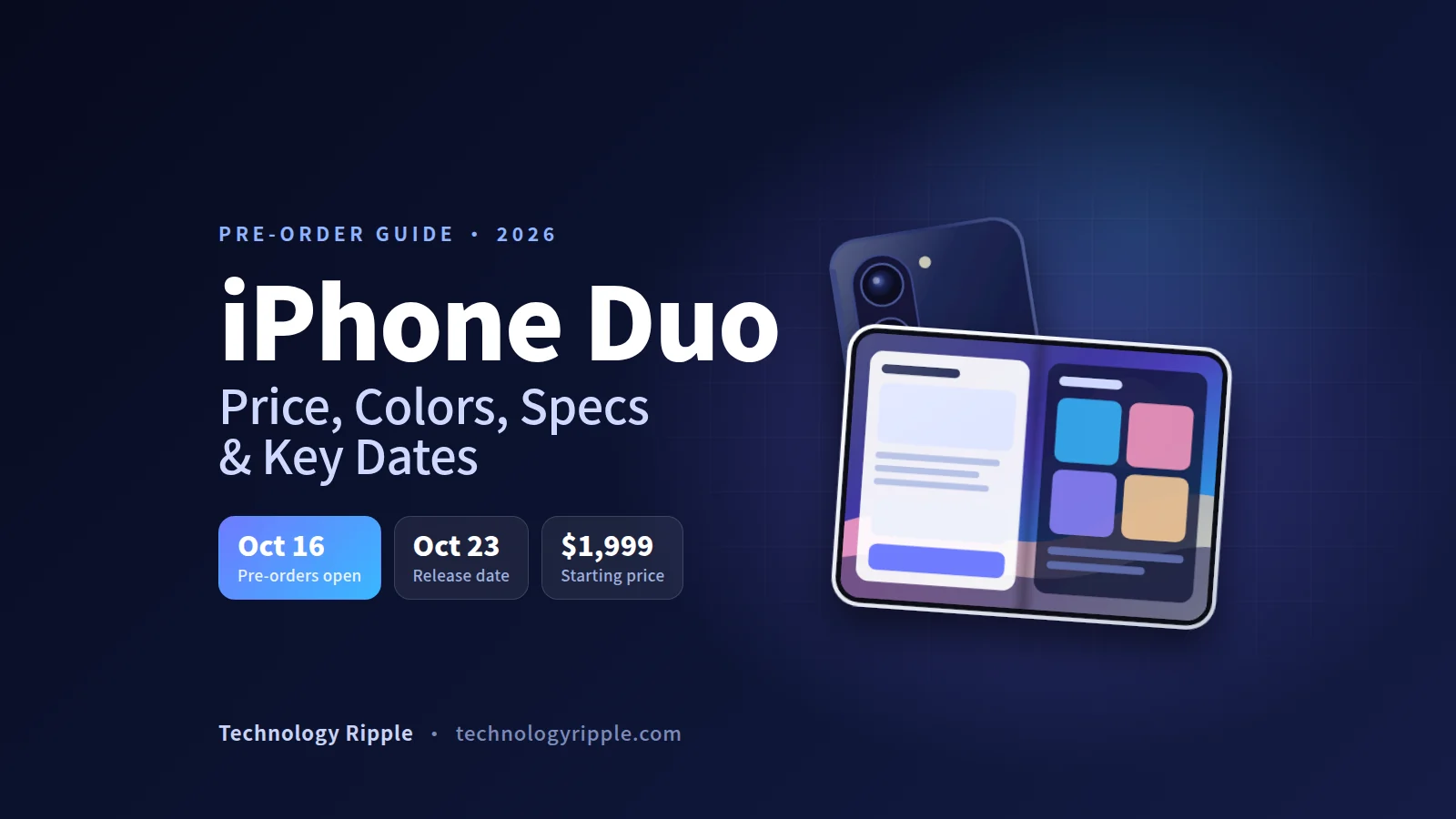
If you’ve been waiting for Apple to make a foldable, your moment is almost here. iPhone Duo pre-orders open on Friday, October 16, at 5 a.m. PT, and the phone lands in stores and on doorsteps on October 23. It starts at $1,999 and comes in two colors: Star White and Night Sky.
That’s a lot of money for a first-generation device, so it pays to know exactly what you’re getting before you tap “Buy.” This guide walks you through every date, every price tier, the full spec sheet, and the trade-offs Apple doesn’t put on its product page. By the end, you’ll know whether to set an alarm for October 16 or sit this one out.
iPhone Duo Pre-Order Essentials at a Glance
| What you need to know | Details |
|---|---|
| Early setup (“Get Ready”) | October 12 |
| Pre-orders open | October 16, 5 a.m. PT / 8 a.m. ET |
| Release date | October 23 (70+ countries) |
| Second-wave launch | October 30 (28 more countries and regions) |
| Starting price | $1,999 (256GB) |
| Storage options | 256GB, 512GB, 1TB, 2TB |
| Colors | Star White, Night Sky |
| Screens | 5.4-inch outer, 7.6-inch foldable inner |
| Chip | A20 Pro |
| Weight | 254 g (8.96 oz) |
When Can You Pre-Order the iPhone Duo?
Apple has split the launch into four key dates. Mark them now, because supply of a brand-new foldable is likely to be tight in the first few weeks.
October 12: Set Up Your Order Early with “Get Ready”
Four days before pre-orders open, Apple lets you prepare your order in advance. You choose your color, storage, carrier, AppleCare+ plan and payment method, then add your shipping and billing details.
Nothing is charged and nothing is ordered yet. The point is speed: when pre-orders go live, you only need to confirm. If stock sells out in minutes, those saved seconds can decide whether your phone arrives on launch day or weeks later.
October 16: Pre-Order Opening Times in Your Time Zone
Pre-orders open at 5 a.m. Pacific Time. Here’s that start time converted for other regions:
| Location | Pre-orders open (Oct 16) |
|---|---|
| US West Coast (PT) | 5:00 a.m. |
| US East Coast (ET) | 8:00 a.m. |
| United Kingdom (BST) | 1:00 p.m. |
| UAE (GST) | 4:00 p.m. |
| Pakistan (PKT) | 5:00 p.m. |
| India (IST) | 5:30 p.m. |
October 23 Launch and the October 30 Second Wave
The iPhone Duo goes on sale in more than 70 countries on Friday, October 23. That’s when the first pre-orders arrive and walk-in stock (if any is left) appears in stores.
If your country isn’t in the first group, you’re likely in the second. Apple adds 28 more countries and regions on October 30.
iPhone Duo Price for Every Storage Size
The iPhone Duo is the most expensive iPhone Apple has ever sold. Even the base model costs $800 more than the iPhone 18 Pro. If you’ve noticed Apple hardware getting pricier across the board, you’re not imagining it; we covered that trend in why your next iPad and Mac will cost more.
Full Price vs Monthly Payment
| Storage | Full price (US) | Monthly on AT&T installments |
|---|---|---|
| 256GB | $1,999 | $55.56 |
| 512GB | $2,199 | $61.12 |
| 1TB | $2,599 | $72.23 |
| 2TB | $3,199 | $88.89 |
Prices outside the US vary with local taxes. Monthly figures are from AT&T’s installment plan and may change with carrier promotions.
256GB, 512GB, 1TB or 2TB: Picking the Right Capacity
Storage is where the price climbs fastest, so be honest about how you use your phone:
- 256GB ($1,999): Enough for most people. If you stream music and video and keep photos in iCloud, you’ll rarely fill it.
- 512GB ($2,199): The sweet spot if you shoot a lot of 4K video or 48MP photos, or you download movies for flights.
- 1TB ($2,599): Worth it only if you edit video on your phone or refuse to pay for cloud storage.
- 2TB ($3,199): A niche option for professional creators. For most buyers, the extra $1,200 is better spent elsewhere.
Do You Save Anything by Pre-Ordering?
No. Apple charges the same price whether you pre-order on October 16 or buy in November. Pre-ordering buys you time, not a discount.
The real savings come from two places. The first is trading in your current phone, through Apple or your carrier. The second is carrier offers, which can include bill credits tied to a new line or plan. Compare both before you commit, because the difference can run to hundreds of dollars.
Star White or Night Sky: Choosing Your iPhone Duo Color
Apple kept the palette simple this time. You get two finishes, and both pair with a titanium frame:
- Star White: A bright, clean finish that looks especially crisp when the phone is open like a small tablet.
- Night Sky: A deep, navy-toned dark finish for a more understated look.
There’s no wrong choice, but here’s one practical tip. Foldable cases usually cover less of the phone than regular cases, because they have to leave the hinge free. That means more of your color stays on show, so pick the one you’ll be happy looking at every day.
If you’re not in a rush, wait until October 23 and see both in a store first. Colors often look different in person than they do on a screen.
iPhone Duo Specs, Explained Simply
Spec sheets can be hard to read, so here’s what each number actually means for you.
Two Screens: 5.4-Inch Cover and 7.6-Inch Foldable Panel
Closed, you use a 5.4-inch outer display for quick tasks like messages, maps and payments. Open it, and you get a 7.6-inch inner display, the largest screen Apple has ever put on an iPhone.
Both screens are OLED and run at up to 120Hz with ProMotion, so scrolling feels smooth either way. The inner screen has a matte nano-texture finish to cut glare, and Apple says the crease down the middle is minimal. You can also run two apps side by side with Split View, which is where a foldable really earns its keep.
A20 Pro Chip: What It Means for Speed and AI
The iPhone Duo uses the A20 Pro, the same chip as the iPhone 18 Pro. It has a 6-core CPU, a 7-core GPU and a dual 16-core Neural Engine.
In plain terms, you’re not giving up any speed for the foldable design. That Neural Engine also powers Apple Intelligence and the new Siri AI. If you’re still unsure how much those features matter day to day, read our take on whether Apple Intelligence is really worth it.
Dual 48MP Cameras and the Under-Display Selfie Camera
On the back, you get two 48MP cameras: a main camera and an ultra-wide. The main camera offers 2x optical-quality zoom and up to 10x digital zoom.
For selfies and video calls, there’s a 12MP Center Stage camera on the outer screen. There’s also an under-display camera hidden beneath the inner screen, so the big display has no notch or cut-out.
Battery Life and 50% Charge in About 20 Minutes
Battery life is one of the Duo’s surprise strengths, thanks to a dual-battery design:
- Up to 44 hours of video playback using the outer screen
- Up to 31 hours of video playback using the inner screen
- 50% charge in about 20 minutes with a 60W-capable USB-C adapter (sold separately)
- Up to 25W wireless charging with MagSafe
Only a USB-C cable comes in the box, so budget for a fast charger if you don’t already own one.
Titanium Build, 254 g Weight and IP68 Water Resistance
The frame and hinge cover are Grade 5 titanium, with Ceramic Shield 2 glass on the front and back. The phone is rated IP68, which means it can survive a depth of 6 meters for up to 30 minutes.
It measures just 5.2 mm thin when open and 11.3 mm when closed. It weighs 254 g, noticeably heavier than a standard iPhone. More on that in the trade-offs below.
eSIM Only, Wi-Fi 7 and USB-C
There’s no physical SIM tray; the iPhone Duo uses dual eSIM only. You also get 5G, Wi-Fi 7, Bluetooth 6 and a USB-C port with USB 3 speeds of up to 10Gb/s. It ships with iOS 27.1; our WWDC 2026 recap covers what’s new in iOS 27.
Full iPhone Duo Spec Sheet
| Feature | iPhone Duo |
|---|---|
| Outer display | 5.4-inch OLED, 460 ppi, up to 120Hz |
| Inner display | 7.6-inch foldable OLED, 430 ppi, up to 120Hz |
| Chip | A20 Pro (6-core CPU, 7-core GPU) |
| Rear cameras | 48MP main + 48MP ultra-wide |
| Front cameras | 12MP Center Stage (outer) + under-display camera (inner) |
| Video playback | Up to 44 hrs (outer) / 31 hrs (inner) |
| Charging | 50% in ~20 min wired (60W adapter); 25W MagSafe |
| Security | Touch ID in the side button |
| Build | Grade 5 titanium frame, Ceramic Shield 2 |
| Water and dust | IP68 (6 m for 30 min) |
| Thickness | 5.2 mm open / 11.3 mm closed |
| Weight | 254 g (8.96 oz) |
| Storage | 256GB, 512GB, 1TB, 2TB |
| Connectivity | 5G, Wi-Fi 7, Bluetooth 6, dual eSIM, USB-C (10Gb/s) |
Specs are taken from Apple’s official iPhone Duo spec sheet.
5 Trade-Offs Worth Knowing Before You Buy
Apple’s product page tells you what the iPhone Duo does well. Here’s what it doesn’t mention up front.
- No Face ID. The Duo unlocks with Touch ID in the side button, not Face ID. If you’ve grown used to your phone unlocking the moment you look at it, this will take some adjustment.
- It’s heavy and thick when closed. At 254 g, it’s about 43 g heavier than the iPhone 18 Pro, and at 11.3 mm closed, it’s noticeably chunkier in a pocket.
- No telephoto camera. You get two rear cameras instead of the three on the iPhone 18 Pro. That means only 2x optical-quality zoom, so distant subjects and portraits won’t look as sharp.
- eSIM only. There’s no SIM tray. That’s fine in the US, but if you travel and like buying local physical SIM cards, check that your destinations support eSIM first.
- Apple Pencil support comes later. The Duo’s big inner screen is well suited to note-taking, but Pencil support only arrives through a software update later in 2026.
None of these is a deal-breaker on its own. Together, though, they’re the price you pay for being an early adopter of Apple’s first foldable.
iPhone Duo or iPhone 18 Pro: Which One Should You Order?
If you’re buying a new iPhone this fall, this is probably the real decision. Both run the same A20 Pro chip, so the choice comes down to screen size, cameras and price.
| Feature | iPhone Duo | iPhone 18 Pro |
|---|---|---|
| Starting price | $1,999 | $1,199 |
| Display | 5.4-inch outer + 7.6-inch foldable inner | 6.3-inch OLED |
| Chip | A20 Pro | A20 Pro |
| Rear cameras | Two 48MP (main + ultra-wide) | Three 48MP (main + ultra-wide + 4x telephoto) |
| Best zoom | 2x optical-quality | 8x optical-quality |
| Front camera | 12MP + under-display camera | 18MP |
| Unlock | Touch ID | Face ID |
| Video playback | Up to 44 hrs (outer) / 31 hrs (inner) | Up to 36 hrs |
| Weight | 254 g | 211 g |
| Thickness | 11.3 mm closed | 8.75 mm |
| Frame | Titanium | Aluminum |
Pick the iPhone Duo if you want a tablet-sized screen in your pocket for reading, multitasking or watching video, and you’re happy to pay $800 extra for it.
Pick the iPhone 18 Pro if photography matters most to you, you prefer Face ID, or you want a lighter phone that fits any case and pocket.
How to Secure an iPhone Duo on Launch Day
First-generation Apple products often sell out fast, and a foldable with a complex hinge is harder to build in volume. Follow these steps to give yourself the best chance.
Your Step-by-Step Pre-Order Checklist
- Check your trade-in value now. Look up what your current phone is worth through Apple and your carrier so you know your real cost.
- Decide on storage and color in advance. Use the guidance above so you’re not deliberating while stock disappears.
- Use “Get Ready” on October 12. Save your configuration, payment method and addresses so checkout takes seconds.
- Sign in before pre-orders open. Log in to your Apple Account or carrier account a few minutes before 5 a.m. PT on October 16.
- Decide on AppleCare+. A foldable screen and hinge are more expensive to repair than a standard iPhone, so accidental damage cover is worth serious thought.
- Check the delivery estimate before you confirm. If it has already slipped past October 23, consider an in-store pickup slot instead.
Apple Store vs AT&T, Verizon and T-Mobile: Where to Order
Order from Apple if you want an unlocked phone, the simplest trade-in process and the widest choice of pickup times.
Order from your carrier if you’re staying on your current plan and want to spread the cost over 36 months. Carriers also run their own launch offers, so compare them against Apple’s trade-in price before you decide. Read the fine print, because the best carrier deals usually require a specific plan or a new line.
Our Verdict: Who Should Pre-Order and Who Should Wait
The iPhone Duo is Apple’s boldest iPhone in years. It’s fast, the battery life is strong, and a 7.6-inch screen changes how you use a phone. But it’s also a first-generation product with a first-generation price.
Pre-order on October 16 if you:
- Read, browse or multitask on your phone for hours every day
- Have wanted a foldable but didn’t want to leave the iPhone ecosystem
- Can comfortably afford $2,000 or more and like being first
Wait a few weeks (or a generation) if you:
- Care most about camera zoom and portrait photos
- Rely on Face ID or want the lightest phone possible
- Would rather see real-world reviews of the hinge and crease before spending this much
If you’re on the fence, waiting costs you nothing but time. The price won’t drop at launch, and early reviews will tell you a lot about how the Duo holds up in daily use.
iPhone Duo Pre-Order FAQs
Pre-orders open on Friday, October 16, at 5 a.m. PT (8 a.m. ET). You can prepare your order in advance with Apple’s “Get Ready” option from October 12.
No. The price is the same before and after launch, starting at $1,999. To lower your cost, look at trade-in values and carrier offers instead.
Apple’s pitch is simple: the largest iPhone display ever, in a design that still folds down to fit your pocket. It also lets Apple compete directly with Samsung and Google, which have sold foldables for years.
No. The iPhone Duo uses Touch ID, built into the side button, to unlock the phone and approve payments.
Yes, within limits. It’s rated IP68, which covers a depth of 6 meters for up to 30 minutes. That makes it water resistant, not waterproof. We explain the difference in is the iPhone waterproof or just water resistant?
The first wave of more than 70 countries gets it on October 23, including the US. Another 28 countries and regions follow on October 30. Check Apple’s website for your country’s date.
Not at launch. Apple Pencil support is due through a software update later in 2026.
