

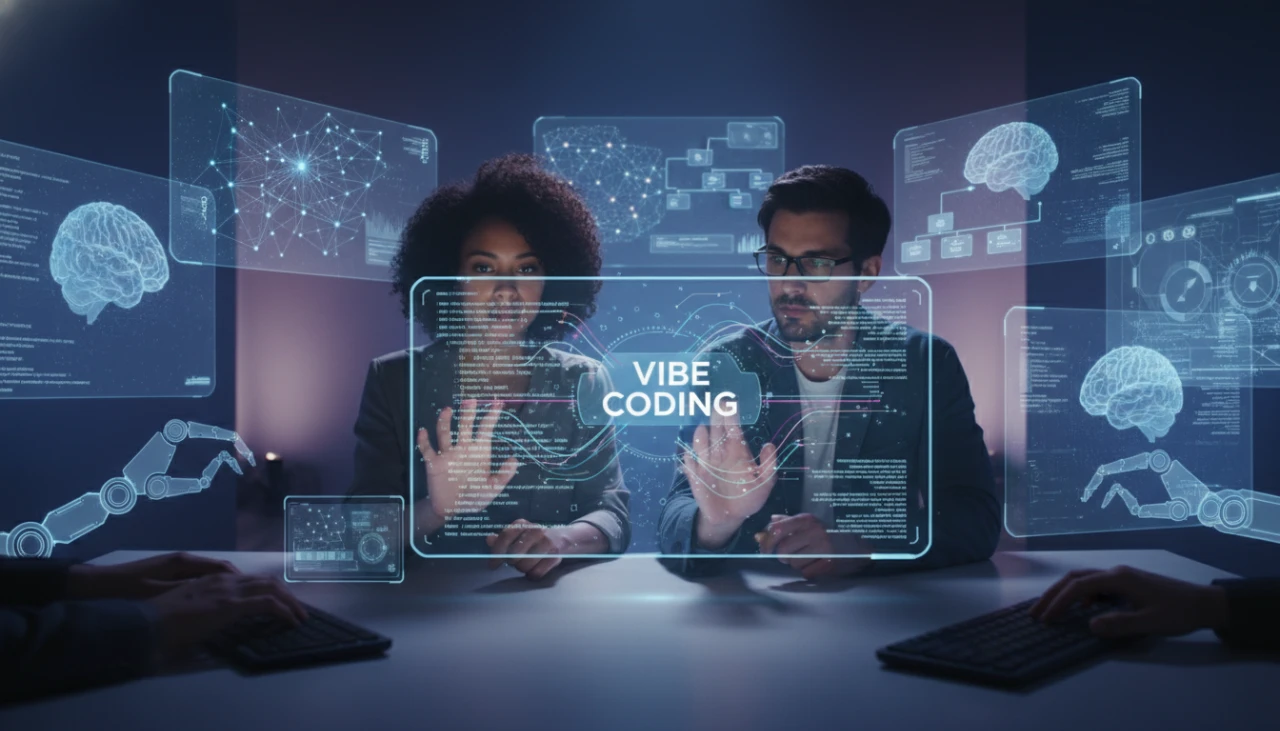
For decades, the distance between having a great idea and actually launching a functional application was measured in months of study and thousands of lines of code. You had to master the logic of loops, the strictness of semicolons, and the complexity of memory management before you could see your vision on a screen. Today, that wall is falling down as the process of building software becomes more about how you think and less about how you type.
The tech movement of 2025-2026 is defined by “Vibe Coding,” a method where the human provides the direction and the AI handles the execution. We are moving away from manual, line-by-line construction toward a system of high-level intent expression where your spoken or written words serve as the primary input.
This article explores the tools like Claude Code and GitHub Copilot 2026, the philosophy behind the movement, and how this change affects the global job market.
Defining Vibe Coding: More Than Just a Buzzword

Understanding the origins of this movement helps you see why this method is gaining ground so quickly among both experts and beginners. Below are the core pillars of the movement.
The Andrej Karpathy Influence. The term gained widespread attention after observations made by Andrej Karpathy, a leading figure in the AI field, in early 2025. He noted a specific state of flow where a developer stops worrying about the specific lines of code and simply “gives in to the vibes” of the project. This shift suggests that the most successful creators are those who can guide an AI through the feeling and function of an app rather than those who spend hours fixing syntax errors.
Programming by Intent. At its heart, this concept moves the work from implementation to vision. Instead of telling the computer exactly how to perform a task, you tell it what you want the result to be. The human acts as a director or an architect, providing the “vibe” or the goal, while the AI agent manages the file structures, logic flows, and technical requirements needed to make that goal a reality.
Natural Language as the New Syntax. In this environment, your native language becomes the most powerful tool in your belt. Whether you are using English or another spoken language, you are essentially writing “natural language programming” that the AI translates into executable files. This removes the need to memorize proprietary languages and allows you to communicate with your software the same way you would with a human assistant.
From Logic to Aesthetic. The focus has shifted from internal logic to the final experience of the user. Instead of asking “Does this loop work?”, a creator asks, “Does this app feel right?” This means developers spend more time on the visual flow, the user interface, and the overall mood of the product, ensuring that the software matches the intended aesthetic and utility.
The Accessibility Angle. This change signals the end of an era where software creation was guarded by technical difficulty. When you remove the requirement of a computer science degree, you open the door for entrepreneurs, artists, and designers to build their own tools. It democratizes the ability to create, making the “how” of development less important than the “what” and the “why.”
How Vibe Coding Works: The Modern “Prompt-to-Product” Workflow

You no longer need to plan every variable before you start building your application. These phases show how a typical session unfolds in a modern development environment.
Phase 1: High-Level Intent. You begin with a broad description of what you want to achieve rather than a technical specification document. For example, you might tell your AI assistant to “build a minimalist budget tracker that works offline and uses purple as the primary color.” This initial prompt sets the boundaries for the AI and gives it a starting point to begin its work.
Phase 2: Autonomous Generation. Once you provide the intent, the AI agents take over the heavy lifting. They build the entire backend, set up the frontend components, and organize the file structure without your intervention. This is a massive change from traditional methods where you would have to manually create every directory and install every library yourself.
Phase 3: The Iterative “Vibe Check.” After the first version is ready, you enter a conversational loop with the software. You look at what was built and provide feedback like “make the text larger” or “add a button to export this to a spreadsheet.” The AI modifies the existing code in real-time, allowing you to refine the project until the function and the feeling are exactly what you wanted.
Phase 4: Instant Remediation. When bugs appear, the AI identifies them and patches the logic errors immediately based on your feedback. You don’t have to look through thousands of lines of text to find a missing comma; you simply tell the system that something isn’t working right. The agent runs its own tests, finds the root of the problem, and fixes it before you even see the technical details.
Phase 5: Vibe Deploying. The final step is moving the app from your local machine to the internet with a single command. Modern tools have integrated cloud hosting that manages the servers, databases, and security settings automatically. This removes the need for deep DevOps knowledge, allowing you to go from an idea to a live URL in minutes.
The Power Players: AI Coding Assistants in 2026
The software market in 2026 is dominated by platforms that prioritize natural communication over traditional text editors. These tools represent the current state of the art for modern creators.
Claude Code & Voice Mode. Anthropic has moved beyond simple chat interfaces to create a deep reasoning engine that can hear and speak. Using Claude Code with voice mode allows you to build applications hands-free while you walk around your office or sit on your couch. You talk through your ideas, and the AI interprets your tone and intent to write and test the software in the background.
GitHub Copilot 2026. What started as an autocomplete tool has grown into a full-scale autonomous collaborator. In 2026, Copilot manages entire repositories, suggesting structural changes and watching for security flaws across thousands of files. It acts as a senior partner that understands the long-term goals of your project, making it much more than a simple coding assistant.
Cursor & Windsurf. These are AI-native development environments that replace traditional editors like VS Code. They are built from the ground up to understand the context of your entire project, meaning they can predict what you need before you even finish your thought. They offer a seamless experience where the AI and the human work in the same space at the same time.
Replit Agent. This tool lives entirely in the browser, allowing anyone to build and host full-stack apps without installing anything on their computer. It is specifically designed for non-technical users who want to see results fast. You give the agent a prompt, and it builds, tests, and deploys the app in a managed environment that it controls for you.
v0.dev & Lovable. These platforms focus specifically on the “visual vibe” of modern web development. They turn text descriptions into high-end React or Next.js interfaces that look like they were designed by a professional agency. By focusing on the frontend first, they allow you to create beautiful, responsive user experiences with almost zero manual CSS work.
5 Reasons Why Vibe Coding is the Future of Development
Moving away from manual syntax provides several advantages for both individual creators and large organizations. Here are the primary benefits of this shift.
Radical Reduction in Time-to-Market
The speed at which you can move from a thought to a product is the most visible change. In the past, building a Minimum Viable Product (MVP) required weeks of planning and execution by a team of specialists. Now, you can see your ideas turn into working software in a single afternoon.
Traditional cycles of drafting, coding, and testing are compressed into a single workflow. You move from a concept to a live application while most people are still finishing their first coffee. This speed allows you to test more ideas in a shorter window, which is vital for staying competitive in a fast-moving economy.
If one version of your app fails to connect with users, you don’t lose months of work. You simply adjust the “vibe” and generate a new version immediately. This rapid iteration cycle is changing how startups operate, allowing them to find their market fit much faster than ever before.
Businesses are using this to stay ahead of competitors by building internal tools on the fly. By reducing the wait time for custom software, teams are becoming more agile and responsive to internal needs. The friction of waiting for an IT department to build a simple dashboard is effectively gone.
Lowering the Technical Barrier to Entry
You no longer need to spend years learning the specifics of a programming language to build something useful. Entrepreneurs who lack computer science degrees can now build functional prototypes and internal tools on their own. This opens up software creation to a much wider group of people with diverse backgrounds.
In the past, if you had a great idea for a niche service, you had to hire an expensive agency or find a technical co-founder. Today, you can use natural language programming tools to build the first version yourself. This changes the power dynamic in the tech world, giving more influence to those with the best ideas.
The technical barrier was often used as a form of gatekeeping in the industry. By making the tools easier to use, we are seeing a surge of creativity from people who were previously locked out of the process. This leads to a more diverse range of software that solves problems for specific communities.
Large companies are also benefiting because their non-technical staff can now handle simple automation tasks. Instead of burdening the engineering team with minor requests, a marketing manager can “vibe” a simple data visualization tool into existence. This improves efficiency across the entire organization.
Democratization of Software Creation
The power in the industry is shifting from those who know how to build to those who know what to build. We are entering the era of the “Product Visionary,” where your value is based on your judgment and your understanding of user needs. The AI handles the “how,” while you provide the “what.”
This democratization means that a single person in a remote location can compete with a large team in a tech hub. If your vision is clear and your “vibe” is strong, the AI can execute at a professional level. This levels the playing field for creators around the world.
Software is becoming a tool of personal expression rather than just a commercial product. We are seeing people build apps for their families, their local clubs, or even just for themselves. When the cost of creation drops to nearly zero, software becomes as common as writing a document or making a video.
The shift also changes the way we think about intellectual property and skill. The ability to direct an AI to build a complex system is becoming the new premium skill set. This means that the creative mind is now the most important part of the software development equation.
Elimination of “Boilerplate” Drudgery
Most of the work in traditional coding involves repetitive tasks that don’t require much creativity. Setting up servers, configuring API integrations, and writing basic login logic are chores that take up a lot of time. Vibe Coding allows the AI to handle these soul-crushing parts of the job.
By removing the “boilerplate” drudgery, you can stay focused on the parts of the project that you actually care about. You spend your energy on the unique features and the user experience rather than the plumbing of the application. This makes the process of building much more enjoyable and rewarding.
Developers are finding that they can get more done in a day because they aren’t bogged down by minor technical details. The AI acts as a tireless assistant that handles the routine chores with perfect consistency. This leads to a higher quality of life for people who work with software every day.
Automation of these tasks also reduces the number of simple errors that often plague manual projects. Since the AI follows best practices for standard configurations, the underlying structure of your app is often more stable. You get a solid foundation without having to spend hours building it from scratch.
Enhanced Problem-Solving Capabilities
A single person can now act as a “Force Multiplier,” managing complex systems that previously required a whole team. You can oversee the frontend, backend, and database all at once because the AI is helping you keep track of the connections. This allows for a more holistic approach to problem-solving.
When you aren’t stuck in the weeds of syntax, you can see the bigger picture of how your software interacts with the world. You can identify potential issues in the user flow or the business logic that you might have missed if you were distracted by code errors. This leads to better, more thoughtful products.
The ability to build and test solutions in real-time means you can solve problems as they arise. If a user reports a bug, you can talk to your AI, see the fix, and deploy it in minutes. This level of responsiveness was impossible in the traditional software development model.
Teams are finding that they can tackle much larger challenges than they could before. With the AI handling the execution layer, humans can spend their time thinking about complex system architecture and long-term strategy. The ceiling for what a small group can achieve has been raised significantly.
The Risks and Realities of “Vibing” Your Code

While the speed of creation is impressive, you must remain aware of the potential downsides that come with automated generation. These challenges require careful management to ensure your software remains viable.
The Hidden Danger of Technical Debt
When you generate code rapidly through natural language, it is easy to ignore the underlying structure. Over time, this can lead to “spaghetti code” that is difficult to maintain or update. If the AI is just trying to satisfy your immediate request, it might take shortcuts that create problems later.
Without a clear architectural plan, your project can become a mess of disconnected pieces. This technical debt might not be visible at first, but it will slow you down when you try to add complex features in the future. You might find that the AI starts to struggle because the foundation it built is too weak.
It is important to periodically audit the code that the AI produces to ensure it follows good practices. Even if you aren’t a professional engineer, you should ask the AI to explain its choices and look for ways to simplify the structure. Maintaining a clean project is still a human responsibility.
The ease of generation also leads to “bloat,” where your app includes more libraries and files than it actually needs. This can make your application slow and heavy for users. A good creator knows when to tell the AI to trim the fat and keep things efficient.
Security and Privacy Vulnerabilities
AI models are trained on vast amounts of data, which sometimes includes deprecated libraries or insecure coding patterns. If you aren’t careful, your “vibe-coded” app could include a security flaw that an attacker could exploit. A non-technical user might not spot these vulnerabilities until it is too late.
There is also the risk of “hallucinated” code, where the AI suggests a library or a function that doesn’t actually exist. In some cases, hackers create malicious packages with those same names, hoping an AI will suggest them to an unsuspecting user. This creates a new kind of supply chain risk for developers.
Privacy is another concern when using AI assistants. You must be careful about the data you share with the model, especially if you are working with sensitive customer information. Most professional tools offer privacy modes, but you still need to be diligent about how your data is handled.
To manage these risks, you should use automated security scanning tools to check your AI-generated code. These systems can find common vulnerabilities and suggest fixes before you go live. Security should never be left entirely to the “vibe” of the project.
The “Shallow Engineer” Crisis
There is a growing concern that new developers may lose the ability to solve problems from first principles. If you always rely on an AI to write your code, you might not understand how the software actually works. This could lead to a generation of “shallow engineers” who are helpless when the AI fails.
When the AI hits a wall or produces a complex bug, a creator who doesn’t understand the basics will be stuck. The ability to read code and understand logic remains a vital skill, even in an automated world. Without it, you are entirely dependent on the tool you are using.
This shift might also change the value of experience in the job market. If anyone can “vibe” a basic app, the only way to stand out is to have a deep understanding of system design and complex problem-solving. The middle ground of “junior” coding tasks is being eaten by automation.
Education will need to pivot from teaching syntax to teaching oversight and critical thinking. We need to ensure that the next generation of builders understands the “why” behind the software, even if they aren’t doing all the “how” manually. Balance is key to long-term success.
Loss of Granular Control
“Vibing” your code often feels like working with a “black box.” You give an instruction and get a result, but you might not know exactly how the AI achieved it. This can make it difficult to perform very specific or highly optimized tasks that require manual precision.
If you want a specific animation to behave in a very particular way, it can sometimes be frustrating to get the AI to understand your exact vision. Natural language is powerful, but it can also be vague. Sometimes, typing a single line of code is still faster than trying to describe a complex visual behavior.
As projects grow larger, the loss of control becomes more apparent. You might find that the AI starts making decisions that conflict with your long-term goals because it lacks the full context of the project. Managing the AI’s “agency” is a constant challenge for vibe coders.
The best approach is a hybrid one, where you use the AI for the heavy lifting but step in manually when precision is required. Learning where to let go and where to take the wheel is a skill that takes time to master. You want the AI to be your assistant, not your master.
Dependency on LLM Providers
When you build your business entirely through vibe coding, you are becoming dependent on the company that provides the AI model. If they change their pricing, update their terms, or experience a service outage, your ability to work is directly affected. This is a strategic risk that every creator must consider.
The code you generate is yours, but the “brain” you used to build it belongs to someone else. If you lose access to that specific model, you might find it difficult to maintain the project using a different AI. Every model has its own “style” and way of organizing information.
There is also the question of model “drift,” where an AI might get worse at certain tasks after an update. If the tool you rely on suddenly starts producing lower-quality code, your productivity will take a hit. Diversifying the tools you use can help mitigate this risk.
Finally, the cost of these high-end AI assistants can add up over time. While they are cheaper than hiring a full team, they are not free. You need to ensure that your business model can support the ongoing costs of the “vibe” that keeps your software running and evolving.
Natural Language Programming Tools: A Comparative Look
Choosing the right environment depends on your technical background and the complexity of the project you are building. Below is a comparison of the different categories available to modern creators.
Traditional IDEs (VS Code) vs. AI-Native IDEs (Cursor). Traditional editors were built for manual typing and now have AI plugins added to them. In contrast, AI-native IDEs like Cursor are designed with the AI as the core experience. This allows for a much smoother flow where the AI has a better understanding of your files and can make changes across the whole project with more accuracy.
Text-to-Code vs. Voice-to-Code. Most people are used to typing their prompts into a chat box. However, the voice mode in tools like Claude Code is changing the ergonomics of development. Voice allows for a more natural expression of intent and can be much faster for high-level planning, while text remains better for specific, granular adjustments.
No-Code vs. Vibe Coding. No-code tools use visual blocks to build apps, which often locks you into a proprietary system. Vibe Coding is superior because it generates real, exportable code in standard languages like JavaScript or Python. This gives you the freedom to move your project to any hosting provider or even hire a human developer to take over later.
The Role of Agents. Standard LLM prompts just give you a text response that you have to copy and paste. Autonomous agents go much further by actually executing the code, running tests, and checking for errors. Agents are the true “digital coworkers” of the vibe coding world because they take responsibility for the outcome rather than just the suggestion.
The Future of Software Development 2026 and Beyond
Looking ahead, the role of the creator will continue to change as systems become more autonomous and interconnected. These predictions suggest how the industry will change in the coming years.
The Rise of the “AI Orchestrator.” The job title of “Junior Developer” is being replaced by the “AI Orchestrator.” This role involves managing multiple AI agents to build complex systems. Your value is no longer about how fast you can write a function, but how well you can coordinate a team of digital workers to achieve a business goal.
Micro-SaaS Explosion. Because the cost of building software is dropping so low, we will see a massive influx of “Micro-SaaS” products. These are small, niche tools built by individuals to solve very specific problems. We are moving toward a world where there is a custom piece of software for almost every hobby and small business.
The Evolution of Education. Computer Science degrees are starting to pivot away from teaching syntax. The new curriculum focuses on system design, data architecture, and AI oversight. Students are learning how to be the “human in the loop” who ensures that the AI’s output is secure, ethical, and efficient.
Collaborative Vibes. In the future, teams will “vibe” together in real-time. Imagine a meeting where three people describe their ideas to a central AI, which then synthesizes those intents into a single application on the fly. Development will become a social, creative activity rather than a solitary technical one.
Best Practices for Effective Vibe Coding
To get the most out of these systems, you need to develop a specific set of skills for directing and refining AI output. These guidelines help you maintain quality while working at high speeds.
Start with “Small Vibes.” It is a mistake to ask for a “complete Facebook clone” in a single prompt. Instead, build your project modularly by focusing on one small feature at a time. This keeps the AI focused and makes it much easier to test and debug each piece before moving on.
Master the “Context Window.” The AI is only as good as the information you give it. Make sure to provide the right documentation, file references, and style guides to ensure the vibe stays consistent. If the AI knows exactly what the rest of the project looks like, it will produce much better results.
Always Perform a “Sanity Check.” Even as a vibe coder, you should learn the basics of reading code. You don’t need to be an expert, but you should be able to spot obvious hallucinations or strange logic. A quick scan of the AI’s output can save you hours of frustration later on.
Iterate, Don’t Re-prompt. If the AI produces something that is slightly off, don’t just delete it and start over. Instead, talk to the AI and tell it what to change. Refining an existing output is much more efficient and helps the AI understand the specific “vibe” you are trying to achieve for that project.
Document the Intent. While the AI writes the code, you should keep a log of why you made certain decisions. Documenting your intent is more important than documenting the syntax. This helps you—and the AI—remember the goals of the project when you come back to it months later for updates.
Embracing the Next Phase of Coding
Vibe Coding is not just a passing trend; it represents a permanent change in how humans interact with computers. We have moved from the era of manual calculation to the era of assisted creation, where the only limit is the clarity of your vision. This shift allows more people to participate in the digital economy and brings us closer to a world where software is as accessible as speech.
Despite the power of these new tools, the human element remains the most important variable in the equation. Your creativity, judgment, and empathy are what turn a collection of code into a product that people actually love. AI can handle the execution, but it cannot provide the soul of the project. That is your job.
The best way to understand this change is to experience it for yourself. Try using a tool like Claude Code or Replit Agent to build a small project this weekend. Once you experience your first “vibe session” and see an app come to life through your words, you will never look at software development the same way again.
Frequently Asked Questions (FAQ)
Is Vibe Coding actually “coding”?
Yes, but it is a higher-level form of coding. You are still providing logic and structure to a computer, but you are doing it through natural language rather than mathematical syntax. It is simply the next step in the evolution of programming.
Do I need to learn Python or JavaScript in 2026?
You don’t need to be an expert, but knowing the basics is very helpful. Being able to read the code that the AI generates allows you to perform better “sanity checks” and helps you understand the limitations of the system you are building.
Will Vibe Coding replace professional software engineers?
It will change their role rather than replace them. Engineers will move from writing simple functions to designing complex systems and overseeing AI agents. The demand for deep technical knowledge will still exist for high-performance and high-security applications.
What are the best free tools to start Vibe Coding today?
You can start with the free tiers of tools like Cursor or the Replit Agent. Even using a standard chatbot like Claude 3.5 Sonnet to generate code blocks is a great way to practice the “prompt-to-product” mindset.
How do I ensure my “vibe-coded” app is secure?
Always use automated security scanning tools and ask the AI to perform a security audit on its own code. Whenever possible, have a more experienced person review the sensitive parts of your application, such as login systems and data handling.
