




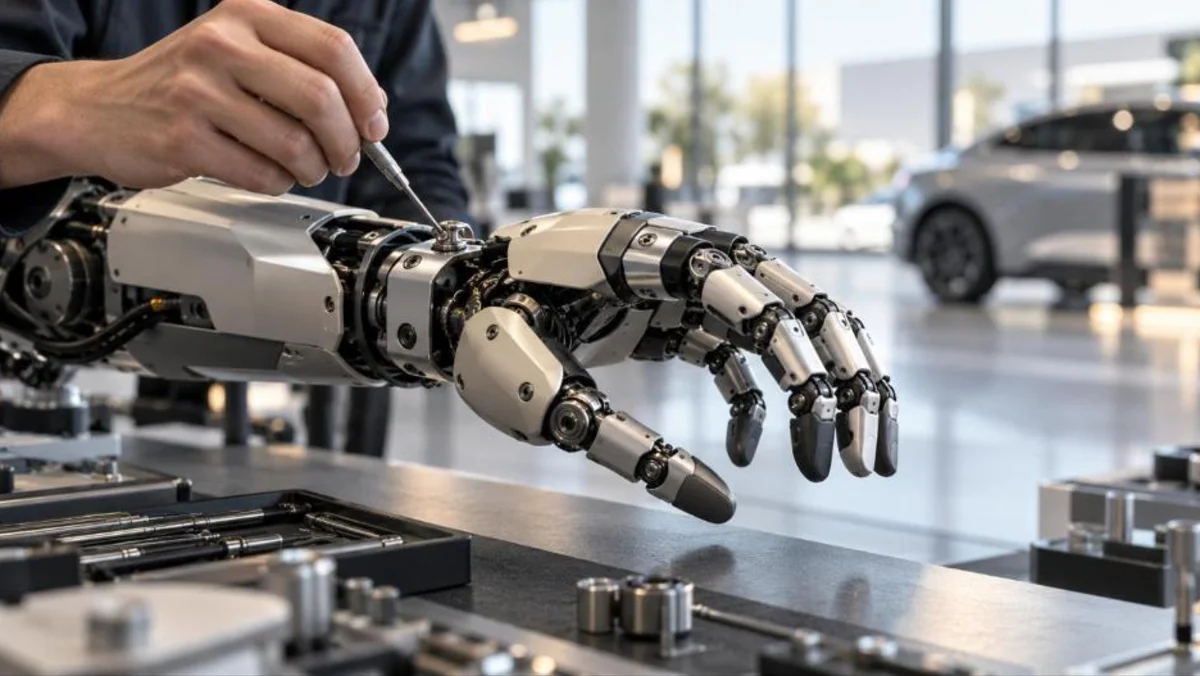
If you’ve been waiting to see the BYD humanoid robot promised for August, the clearest look now comes through a patent filing. Published by CNIPA on October 9, 2026, the design shows a black-and-white humanoid with two legs and a rounded head without a screen, closely resembling the reported Xiao Di showroom robot. There’s still no announced price or confirmed launch date, and a formal unveiling remained unconfirmed as of October 9.
| Detail | What we know |
|---|---|
| Patent title | “Embodied AI Robot” |
| Published | October 9, 2026, by China’s patent office, CNIPA |
| Robot name | Reportedly Xiao Di |
| Height | Reported at 1.61 m |
| Weight | Reported at 58.5 kg |
| Degrees of freedom | Reportedly 31 overall, including seven in each hand |
| Hand accuracy | Reported repeat positioning precision of ±1 mm |
| Languages | Six Chinese dialects and six foreign languages |
| First job | Greeting dealership visitors, with two or three robots planned per store |
| Price | No price announced |
| Launch status | No confirmed formal unveiling as of October 9 |
| US availability | Unlikely under reported restrictions on new Chinese humanoid robots |
What the BYD Patent Shows
BYD’s “Embodied AI Robot” filing gives you eight views of a human-shaped machine with two arms and two legs. Its description lists walking, staying balanced and interacting with its surroundings, with uses planned across services, education and industry. That tells you what BYD intends the robot to do, though the drawings establish much less about what it can actually deliver. Before treating this as a finished product, here’s what you can see and where the patent’s evidence stops.
- Head and face. The head has a curved, oval outline and a dark front surface. No display screen appears in the design, so you aren’t looking at a tablet mounted above a pair of shoulders.
- Body panels. Pale coverings sit across sections of the body, arms and legs, giving the robot its black-and-white appearance.
- Moving joints. You can identify joints at the shoulders, elbows, hips and knees. The overall proportions resemble those of a standing person.
- Exposed mechanisms. Some machinery remains visible around the waist and legs, rather than sitting beneath a continuous outer covering.
- Hands and fingers. The hands have jointed fingers. Those drawings show their physical arrangement, without demonstrating how reliably they can hold or manipulate objects. Hands are the hard part, as Boston Dynamics found with its redesigned Atlas hand.
What a Design Patent Does Not Prove
You see, a design patent protects appearance. It does not verify the robot’s performance, establish that manufacturing is ready, or guarantee that the version reaching customers will look the same. You can examine BYD’s proposed exterior here, but you cannot judge a working product from these images alone.
Xiao Di Specs and Abilities
Want to know how tall it is or what its hands can do? The reported Xiao Di figures come from earlier Di Space information and material shared on social media by a BYD executive, rather than a formal specification sheet. You should therefore treat these numbers as preliminary, especially since published accounts differ slightly on weight. Here’s what has been reported about the robot you could eventually meet in a BYD showroom.
| Specification or ability | Reported details |
|---|---|
| Height | 1.61 m, approximately 5.2 ft |
| Weight | 58.5 kg, approximately 129 lb. Interesting Engineering gives a slightly lower figure of 58 kg |
| Total degrees of freedom | 31 across the robot |
| Hand movement | Seven degrees of freedom in each hand |
| Hand repeat positioning | Reported precision within ±1 mm when returning to a position |
| Language support | Live translation in both directions in six Chinese dialects plus six foreign languages |
| Visual sensing | A 360-degree view and dynamic modeling of its surroundings |
| Human recognition | Recognition of faces, lip movements and gestures |
| Object handling | Grasping objects with its hands |
| Interaction | Responding through gestures and using pointing to support explanations |
| Planned showroom duties | Welcoming you, explaining vehicle features and demonstrating the infotainment system |
The patent drawings resemble Xiao Di, but you still have no confirmation that they show the design BYD will put into production.
How BYD Got Here
If you first heard about BYD’s robot through the October patent, you’re joining a project that began years earlier. The company had already formed a team, backed robotics businesses and tested another maker’s humanoid. Here’s how those steps led to the latest filing.
| Date | Development |
|---|---|
| 2022 | BYD established a team to work on embodied AI |
| August 2023 | The company invested in robot developer Agibot |
| Late 2024 | Reports placed an embodied AI team within BYD’s 15th Business Division, alongside recruitment for senior engineering roles |
| April 2025 | BYD bought a stake in Percibot |
| Date unspecified | UBTech’s Walker S1 underwent trials at BYD’s Changsha factory |
| June 2026 | Stella Li confirmed humanoid development, while BYD rejected several project rumors |
| July 25, 2026 | Zhengzhou’s Di Space teased an upcoming robot appearance |
| July 28, 2026 | BYD confirmed plans for an August presentation |
| August 2026 | The planned presentation month passed without a confirmed formal unveiling |
| October 9, 2026 | CNIPA published the robot’s design patent |
What Happened to the August Debut
You’ll find conflicting accounts here. Interesting Engineering reported an August debut at Di Space, while CnEVPost’s October 9 coverage said the formal unveiling was still pending. We therefore treat August as a promised presentation, with no formal BYD launch confirmed by October 9.
The Yao Codename Rumor
If you’ve seen the name “Yao,” it comes from reports about a “Yao Shunyu” project that BYD rejected. The company also denied claims about a seventh-generation prototype and 20,000 robots being deployed that year. Xiao Di is the only name connected to BYD-linked material.
Where BYD Plans to Use the Robot
Your first encounter with a BYD robot could happen while shopping for a car. The company’s stated plan starts with customer service, before moving into other commercial spaces and eventually homes. Here’s the proposed order, with the later stages still plans rather than confirmed deployments.
- Di Space and dealerships. BYD wants two or three robots per store to welcome you, explain vehicle features and demonstrate the infotainment system. Di Space venues are intended as an early public introduction, while Stella Li has discussed putting robot sales assistants to work within one or two years.
- Supermarkets, malls and warehouses. These are the next proposed destinations after dealership use. They remain part of the medium-term plan, so you shouldn’t read them as locations with confirmed Xiao Di installations.
- Homes. Longer-term ambitions include cleaning, cooking and companionship. If household robots become viable, BYD could use its existing dealerships to sell them, giving you a familiar place to encounter the products.
You see, the showroom plan still leaves a role for people. Li has said robots cannot provide the emotional connection between customers and human sales staff.
Interesting Engineering suggested factories could come first, but that was the outlet’s analysis. BYD’s stated sequence starts with retail, and it denied reports of a factory robot line, despite already using industrial robots and testing UBTech’s Walker S1. Carmakers testing humanoids on the line is not new, as the BMW and Xiaomi factory pilots show.
BYD’s Robotics Bets and Its Manufacturing Edge
Why should you take a carmaker’s robot plans seriously? BYD already produces several components that humanoids need, while its investments and trials give it experience beyond vehicle manufacturing. Here’s what supports its robotics ambitions.
- Agibot and Percibot. BYD invested in Agibot in August 2023 and acquired a Percibot stake in April 2025.
- Factory experience. Trials with UBTech’s Walker S1 at Changsha covered moving materials and identifying parts, giving BYD operational data.
- Shared vehicle technology. Motors, batteries, control systems and chips offer technical foundations that BYD can carry into robotics. Li has said this overlap can reduce development and manufacturing costs.
- Open platform plans. BYD intends to support both its own robots and products developed with partners.
- China-first expectations. Li expects China to commercialize humanoids before other markets. Consultant Ding Haifeng has argued that BYD’s production model could strengthen Chinese carmakers’ robotics capabilities, while identifying capacity and pricing as measures to watch.
There’s commercial pressure behind the plans, too. BYD’s reported NEV sales fell 15.7% in the first half of 2026, while its Hong Kong shares briefly gained more than 2% after the robot announcement was confirmed. For you, manufacturing capacity and an eventual selling price will tell more than that initial market reaction.
Xiao Di Next to Optimus, Walker S2 and Other Humanoids
If you’re comparing humanoids, a price tag alone won’t tell you what you can actually buy. Some robots have entered production, others have delivery targets, and Xiao Di still lacks a confirmed formal launch. Keep those differences in mind as you compare the reported figures below, and see our Tesla Optimus Gen-3 guide for more on Tesla’s robot.
| Robot | Maker | Height | Weight | Notable spec | Price | Status |
|---|---|---|---|---|---|---|
| Xiao Di | BYD | 1.61 m | 58.5 kg | Reportedly 31 degrees of freedom overall | Unannounced | Formal unveiling unconfirmed as of October 9 |
| Optimus Gen-3 | Tesla | 173 cm | 57 kg | Hands with 22 degrees of freedom | $20,000 long-term goal | Limited business sales planned for late 2026 |
| Walker S2 | UBTech | Not published | Not published | Annual production capacity target of 5,000 in 2026 | Not published | Production and deliveries began in November 2025 |
| R1 | Unitree | 1.2 m | About 25 kg | 26 joints | Starting at $5,900 | Announced with a starting price |
| NEO | 1X | 5 ft 6 in | 66 lb | Remote human assistance for difficult chores | $20,000 or $499 monthly | Initial US home deliveries planned for 2026 |
| Iron | Xpeng | Not published | Not published | Undergoing trials | Not published | Mass production targeted for the end of 2026 |
| Aimoga | Chery-incubated Aimoga | Not published | Not published | Consumer sales already reported | Not published | Already sold to consumers |
- Where BYD differs. Its early plan centers on helping you inside dealerships. Its existing stores and component manufacturing give it resources to support that rollout.
- Where BYD trails. You still cannot compare a confirmed Xiao Di price or delivery schedule. UBTech has already begun shipments, while Aimoga has reached consumers.
- Why price labels matter. The $20,000 figure for Tesla Optimus is a future consumer target. NEO’s figure is an advertised purchase option, so treating them as equivalent offers would mislead you.
What This Means for Buyers Outside China
Seeing Xiao Di in a Chinese dealership would not tell you when it might reach your country. BYD has not announced an international buying route, and reported US restrictions create another obstacle. If you’re following the robot from abroad, these are the distinctions that matter.
- US robot restrictions. Reports describe July 28, 2026 FCC action covering foreign advanced robots, including new Chinese humanoids. The reported restrictions apply to models without prior approval, making Xiao Di’s US availability unlikely.
- BYD cars are a separate issue. You cannot currently buy a new BYD passenger car through an official US retail offering. A 100% tariff on Chinese EVs, connected-car rules and safety requirements are among the barriers, although BYD does sell commercial vehicles there.
- Canada has different terms. A reported agreement permits up to 49,000 Chinese EVs at a 6.1% tariff. That vehicle arrangement does not establish Canadian availability for Xiao Di.
- Competition adds context. In January 2024, Elon Musk warned that Chinese automakers could overpower most rivals without trade barriers. His comments help explain the competitive backdrop, but they do not establish whether you can import a particular robot.
Signs to Watch Before Xiao Di Ships
You now have a design to examine and a reported set of abilities to follow. It is one more sign of why many call 2026 the year physical AI went mainstream, with startups such as Mecka AI even paying people to train robots. The next useful step is to watch for evidence that connects those promises to robots working in dealerships. Keep this checklist handy as BYD releases more details.
- A formal Di Space presentation where you can see the robot operating.
- An official specification sheet confirming its dimensions, hand precision and language abilities.
- A selling price and clear information about who can order.
- Named dealerships receiving robots and details of their daily duties.
- Confirmed partners for BYD’s planned open robotics platform.
- Production-related filings or announcements, supported by manufacturing details.
- Any US regulatory changes affecting availability if you live there.
There’s plenty to follow without treating a patent as a shipping notice. Start with BYD’s next formal demonstration, then compare the confirmed abilities with the job you would actually want a robot to do.
FAQs
You cannot currently buy a new BYD passenger car through an official US sales network. Tariffs, connected-car restrictions and safety requirements stand in the way. BYD does sell commercial vehicles in the country, so its passenger-car situation does not apply to every vehicle it makes.
You won’t find one typical price, but published examples include Unitree’s R1 starting at $5,900 and its G1 costing more than $13,000. Those figures relate to different machines, rather than a standard price for humanoids. BYD has not announced what Xiao Di will cost.
1X advertises its $20,000 NEO for chores such as laundry and bathroom cleaning, though difficult tasks can involve remote human assistance. You should therefore distinguish advertised household abilities from fully independent operation. Initial US home deliveries were planned for 2026.
Musk has described Chinese automakers as formidable competitors and warned that most rival manufacturers could struggle against them without trade barriers. He made those comments in January 2024, after BYD overtook Tesla in quarterly EV sales. You should read them as comments about automotive competition, rather than Xiao Di.
You cannot treat an August formal debut as confirmed because published accounts disagree. Interesting Engineering described an August appearance, but CnEVPost reported on October 9 that the formal unveiling remained pending. BYD had previously confirmed plans for an August presentation at Di Space.
No, you should not treat Yao as BYD’s confirmed robot name. BYD rejected reports about a “Yao Shunyu” project, including related prototype and deployment claims. Xiao Di is the name associated with BYD-linked material, although a formal product announcement remains unconfirmed.
