

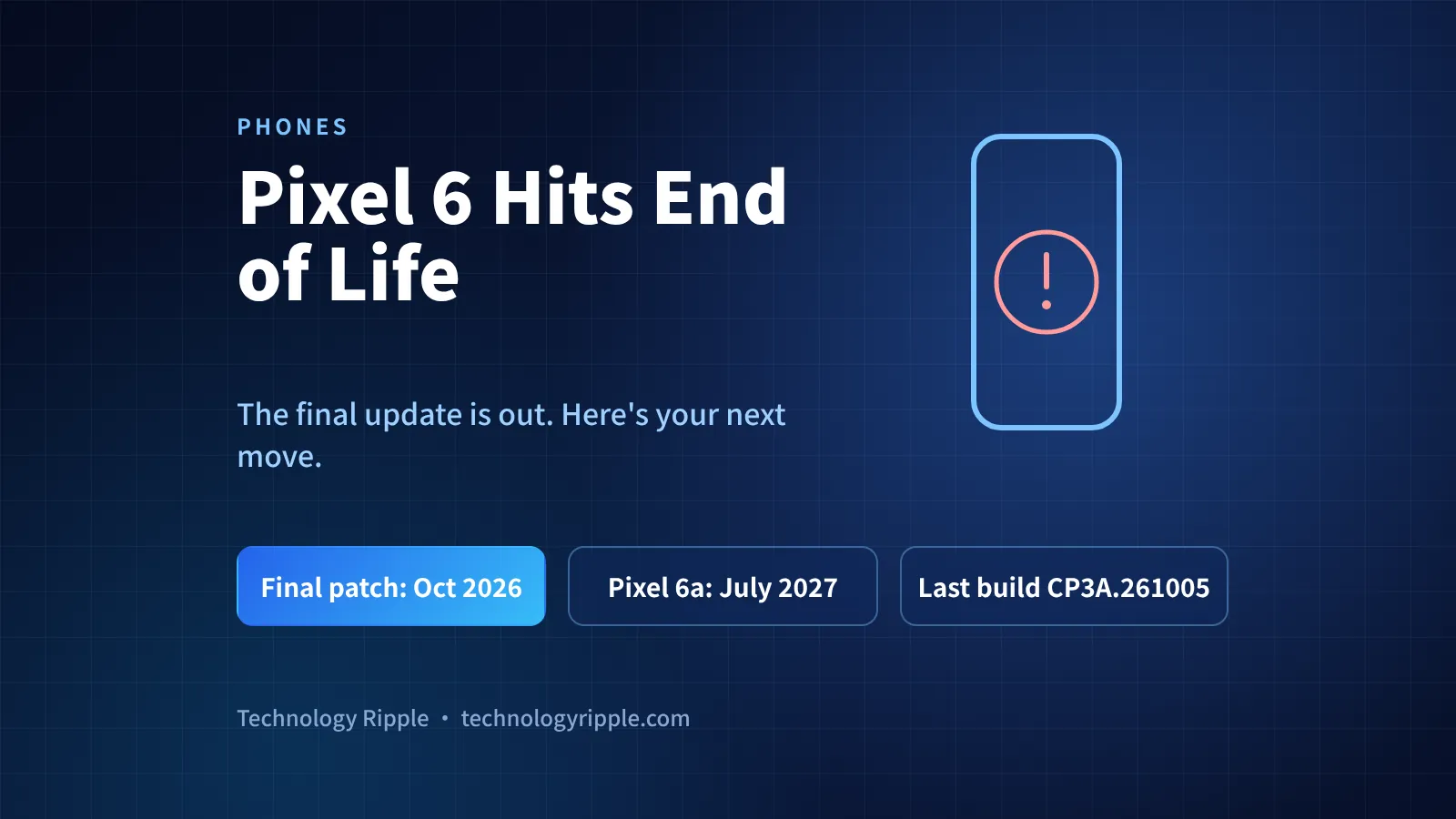
Five years ago, the Pixel 6 launched as the first phone running Google’s own Tensor chip. This week, it became the first Tensor phone to run out of road. The Pixel 6 end of life is official: the October 2026 Pixel update, released on October 6, is the last one the Pixel 6 and Pixel 6 Pro are getting from Google.
Your phone won’t suddenly stop working. But it won’t get any more security patches, bug fixes or Pixel Drops either. So what does that actually mean for you, and should you be shopping for a replacement? Let’s break it down.
| Key fact | Details |
|---|---|
| Phones affected | Pixel 6 and Pixel 6 Pro |
| US launch | October 28, 2021 |
| Final update | October 2026 Pixel update (released October 6, 2026) |
| Final build | CP3A.261005.002.A1 (shared with Pixel 6 to 7a) |
| Last major Android release | Android 17 QPR1 (stable September 15, 2026) |
| Support policy | 5 years of Android and security updates |
| Pixel 6a support | Continues until July 2027 |
Pixel 6 end of life: what actually happened
Google’s policy for the Pixel 6 generation is straightforward. According to Google’s Pixel update support page, the Pixel 6, 6 Pro, 6a, 7, 7 Pro, 7a and the original Pixel Fold get updates “for 5 years starting from when the device first became available on the Google Store in the US.” The Pixel 6 hit shelves in October 2021, so October 2026 is the cutoff.
That 5-year window wasn’t the original deal. Here’s the thing: the Pixel 6 launched with a promise of three years of Android version updates and five years of security patches. Google later stretched the Android version promise to five years as well, which is why these phones made it all the way to Android 17 instead of stopping at Android 15.
The last two steps happened quickly. Android 17 QPR1 rolled out on September 15, 2026, and Droid Life described it as the Pixel 6 Pro’s “final big update.” Then the October patch landed on October 6 with build CP3A.261005.002.A1, and Droid Life noted it “should be the last update for the Pixel 6 and Pixel 6 Pro, as those have reached end of life.”
The key takeaway here is simple: there’s nothing left in the pipeline for these two phones.
Is the Pixel 6a affected too?
Not yet. The Pixel 6a uses the same first-generation Tensor chip, so it’s easy to assume it’s going out with its siblings. It isn’t.
You see, Google counts the five years from each phone’s own US launch. The Pixel 6a arrived on July 28, 2022, nine months after the Pixel 6, so its support runs until July 2027 according to endoflife.date and GrapheneOS’s device table. That gives 6a owners roughly nine more months of patches.
Here’s how the rest of the Pixel lineup looks right now.
| Phone | US release | Updates guaranteed until |
|---|---|---|
| Pixel 6 / 6 Pro | Oct 2021 | Oct 2026 (ended) |
| Pixel 6a | Jul 2022 | Jul 2027 |
| Pixel 7 / 7 Pro | Oct 2022 | Oct 2027 |
| Pixel 7a | May 2023 | May 2028 |
| Pixel Fold | Jun 2023 | Jun 2028 |
| Pixel 8 / 8 Pro | Oct 2023 | Oct 2030 |
| Pixel 8a | May 2024 | May 2031 |
| Pixel 9 series | Aug 2024 | Aug 2031 |
| Pixel 9a | Apr 2025 | Apr 2032 |
| Pixel 10 series | Aug 2025 | Aug 2032 |
| Pixel 10a | Mar 2026 | Mar 2033 |
Notice the jump at the Pixel 8. That’s where Google switched from five years to seven. If you’re upgrading, that gap matters more than any spec sheet.
What stops and what keeps working
Sounds scary, right? It’s less dramatic than it sounds, at least on day one.
Your Pixel 6 will keep turning on, making calls, taking photos and running apps tomorrow exactly as it did yesterday. Nothing gets switched off remotely. What changes is the flow of fixes from Google.
| Feature | After end of life |
|---|---|
| Monthly Pixel security patches | Stopped |
| Android version and QPR updates | Stopped (no Android 17 QPR2 or Android 18) |
| Pixel Drops (new features) | Stopped |
| Device bug fixes | Stopped |
| Google Play system updates | Can continue for modular Android components |
| Google Play Protect | Keeps running |
| Your installed apps | Keep working for now |
| Calls, texts, camera, battery | Unchanged |
That said, the “for now” on apps matters. App developers eventually raise the minimum Android version they support, and banking and payment apps tend to be the strictest. Since your phone is frozen on Android 17, that won’t bite for a while, but it will eventually.
The key takeaway here is simple: your phone works fine today, but it starts aging faster from this point on.
Why missing security patches is a real risk
Let’s back up a little. Each monthly Pixel update closes holes that researchers and attackers have found in Android, in Google’s own code and in chip-level firmware. Once those patches stop, any new flaw discovered next month stays open on your phone forever.
Gadget Hacks put it well when it said the risk “compounds” over time. One missing patch isn’t a crisis. Six months of them, a year of them, and the number of known, documented, unfixed bugs on your phone keeps growing.
“An unpatched phone doesn’t break all at once. It just gets a little easier to break into every month.”
There’s another wrinkle. Even before the end, Pixel 6 updates had become irregular, with Gadget Hacks reporting that the series skipped several monthly patches between July 2025 and August 2026 after moving to a quarterly schedule. So your phone may already be a little behind newer Pixels.
If you’ve noticed odd behavior lately, it’s worth running through the warning signs in our guide on how to know if your phone is hacked. The key takeaway here is simple: the longer you use an unsupported phone for banking, work email or two-factor codes, the more you’re betting on nobody finding a new hole.
What to do next with your Pixel 6
You don’t have to panic-buy a new phone this weekend. But you should have a plan. Here’s what to do, in order.
1. Install the final update right away
First, make sure you’re actually on the last build. Open Settings, tap System, then Software update, and install anything waiting. Google notes that updates roll out gradually and “may take a few weeks” to reach every device, so check again in a few days if nothing shows up.
Being on the October 2026 build means you at least have every fix Google ever shipped for this phone.
2. Back up everything before you change anything
Photos, messages, app data, authenticator codes. Back them up now, while the phone is healthy, not when it’s dying in a drawer. Turn on Google One or Google Photos backup and confirm your two-factor apps can transfer to a new device.
Authenticator apps are the one people forget. Don’t be that person.
3. Move sensitive tasks off the phone gradually
If you want to keep using your Pixel 6 for another few months, that’s reasonable. Just be selective. Keep it for calls, messages, music and photos, and consider shifting banking, payments and work accounts to a supported device as soon as you can.
Also keep Play Protect turned on and only install apps from the Play Store. Those two habits cover a lot of ground on an older phone.
4. Check what your Pixel 6 is worth in trade-ins
Your phone still has value, and it drops every month. In September, Droid Life reported that Google was offering $300 in trade-in credit for a Pixel 6 Pro toward a Pixel 11 Pro. Offers like that change often, so compare Google’s trade-in quote with your carrier’s and with resale prices before you commit.
A phone in good condition with a healthy battery will always fetch more. If yours runs warm or drains fast, our guide on why your phone gets so hot can help you rule out simple fixes first.
5. Consider a custom ROM, but go in with your eyes open
Custom Android builds can stretch a phone’s life, and GrapheneOS still lists the Pixel 6 and 6 Pro as supported right now. Here’s the catch: no third-party project can fix firmware and driver flaws that only Google can patch.
GrapheneOS is refreshingly blunt about this. Its FAQ says extended support releases “cannot provide full security patches and should not be used except as a last resort while planning to get a new device.” Flashing a ROM also involves unlocking the bootloader and wiping your phone, so it’s a project for confident tinkerers, not a quick fix.
6. Pick an upgrade with a long runway
If you’re ready to move on, prioritize update length over flashy features. Every Pixel from the Pixel 8 onward gets seven years of updates, which makes this decision a lot less stressful than it was in 2021.
- Pixel 10a: now $599 in the US after Google quietly added $100 to the price, with updates guaranteed to March 2033.
- Pixel 11: starts at $899 with 256GB of base storage and the Tensor G6 chip, released August 20, 2026.
- Pixel 11 Pro: starts at $1,099, with the Pro XL at $1,299 and the Pro Fold at $1,899.
Not tied to Google? Plenty of Android makers now promise long support too. Our look at the OnePlus 16 is a good place to start if you want to compare outside the Pixel family.
Is the Pixel 6 still worth using in late 2026?
For light use, yes, for a while. The Tensor G1 still handles everyday apps, the camera still takes great photos, and Android 17 QPR1 is a modern, capable build. Plenty of people will keep using these phones into 2027 without noticing anything different.
As a main phone for sensitive accounts, though, the case gets weaker every month. And buying a Pixel 6 or 6 Pro now, even a cheap refurbished one, makes little sense when a supported phone with years of patches ahead is available.
“The best time to plan your upgrade is while your old phone still works perfectly.”
A fond farewell, and a smarter next phone
The Pixel 6 deserves a proper send-off. It introduced the camera bar, kicked off the Tensor era and, thanks to Google’s extension, lasted two years longer on Android updates than it was first promised. That’s a solid run by any phone’s standards.
Now it’s your turn to make the next move on your own timeline. Install that last update, back up your data, check your trade-in value and choose a phone with seven years of support ahead of it. Do that, and the next time an end-of-life notice lands, it’ll be years away.
Frequently Asked Questions
Google’s support for the Pixel 6 and Pixel 6 Pro ended in October 2026, five years after their US launch. The October 2026 update, released on October 6, is expected to be the final one.
No. Android 17 QPR1, released in September 2026, was the last major release for the Pixel 6 and 6 Pro. Google confirmed they would not get the QPR2 beta because they reach end of life before it ships.
No. The Pixel 6a launched in July 2022, so its five-year support window runs until July 2027. It’s still getting regular updates for now.
Yes. The phone keeps working normally, apps keep running and Google Play Protect stays active. The trade-off is that new security flaws will no longer be patched, so the risk slowly rises over time.
Not in terms of performance, since it still handles everyday tasks well. It is obsolete from a security standpoint, though, because it no longer receives fixes, so it’s best treated as a secondary phone over the long run.
Any Pixel from the Pixel 8 onward gets seven years of updates. The Pixel 10a at $599 is the budget pick, while the Pixel 11 at $899 is the current flagship starting point.
