




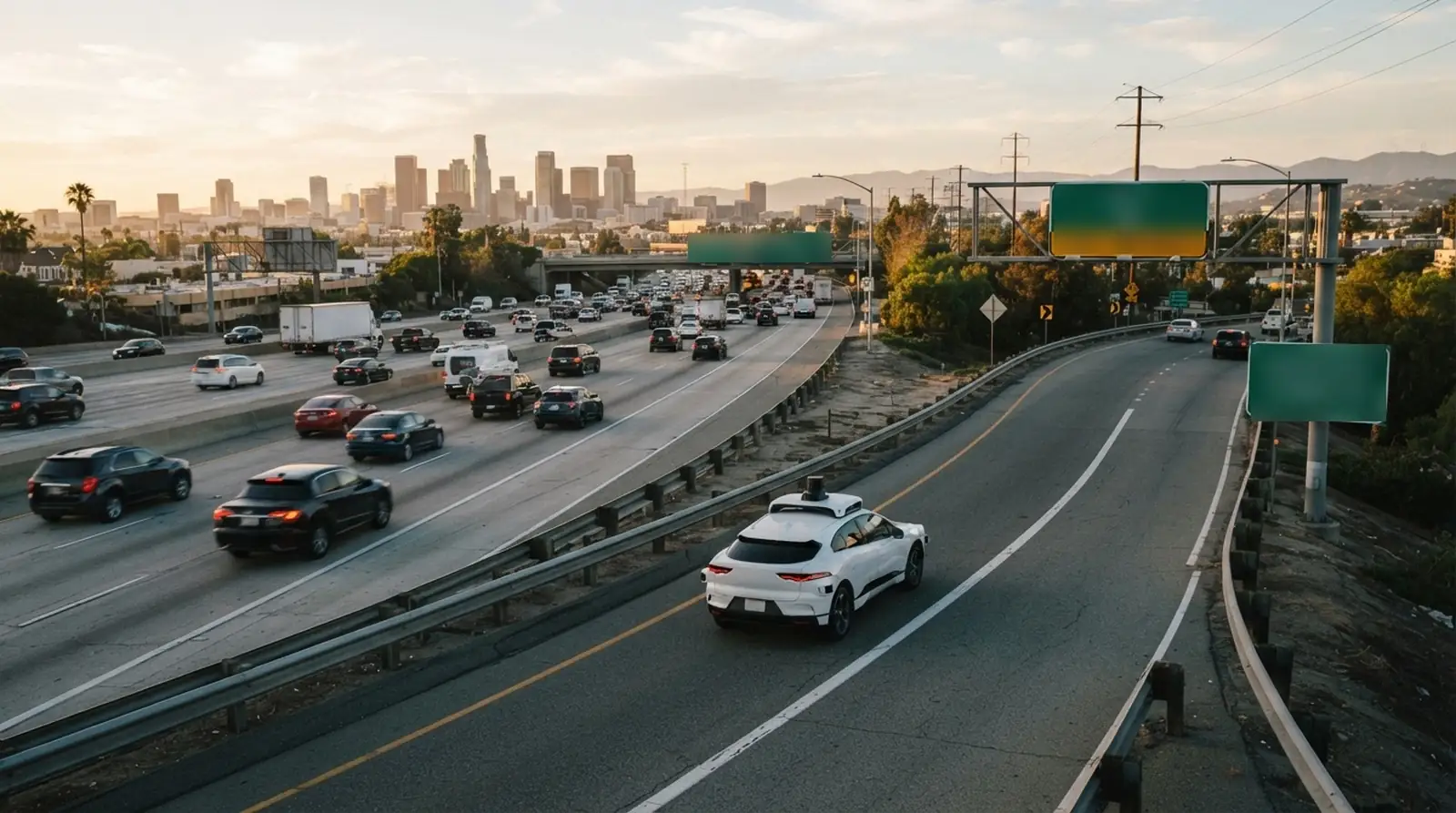
Key Takeaways
- California Freeway Restriction: California’s DMV barred Waymo’s driverless freeway rides and testing effective November 11, 2026, following recurring construction-zone incidents. The restriction became public November 17, while your surface-street rides remain available.
- Longer Routes Ahead: Waymo paused freeway rides in the SF Bay Area, Los Angeles, Phoenix, Miami and Austin. Your airport and cross-town trips may take longer, so check the app’s arrival estimate before booking rather than relying on previous travel times.
- Plan Your Ride: Waymo has no announced freeway restart date, and California requires DMV acceptance of corrective work. Leave extra time for flights, include SFO’s Rental Car Center and AirTrain connection, and compare human-driven rides when your schedule is tight.
If your next Waymo ride is to the airport, give yourself more time. The Waymo freeway ban took effect in California on November 11, 2026, blocking driverless freeway rides and testing, and Waymo has paused freeway rides everywhere it offered them. You can still book a ride on surface streets, but airport runs and longer cross-town trips may take longer.
The restriction became public on November 17. It followed two incidents involving three robotaxis entering a US-101 construction closure near Burlingame and another trying to pass California Highway Patrol vehicles during a traffic break on I-280.
There is no announced end date, so you cannot yet plan around freeway service returning. For now, your next booking depends on the surface-street route available, and the distinction between California’s order and Waymo’s wider pause matters. Here are the key facts before we get into what changes for your ride.
| Item | Detail |
|---|---|
| Who issued it | California DMV through restrictions on Waymo’s permits |
| Effective | November 11, 2026, with the restriction made public November 17 |
| What is barred | Driverless freeway rides and driverless freeway testing throughout California |
| Still allowed | Surface-street rides and freeway testing with trained specialists behind the wheel |
| Waymo’s response | Freeway rides paused in the SF Bay Area, Los Angeles, Phoenix, Miami and Austin |
| Trigger incidents | November 5 US-101 construction closure near Burlingame and November 6 I-280 CHP traffic break |
| End date | None announced. California’s restriction remains until the DMV accepts Waymo’s corrective work |
Why California Ordered the Waymo Freeway Ban
California’s DMV says Waymo’s driverless freeway operations pose “an imminent hazard to public safety.” DMV spokesperson Jonathan Groveman attributed that finding to repeated entries into active construction areas where workers, vehicles and equipment were present. That is the safety concern behind the restriction on your freeway rides.
The problem had already prompted a freeway pause earlier this year. Waymo stopped those rides in May and brought them back in July after a software update intended to improve how its cars handled construction zones. The November incidents show why the DMV is asking for further corrective work before allowing driverless freeway operations again.
Where the Restriction Applies
Here’s the thing. The order reaches beyond the trips you can book as a passenger. It applies to both Waymo’s deployment permit and its driverless-testing permit, so empty cars cannot continue driverless freeway testing in California while passenger rides are suspended.
Testing can continue with trained autonomous specialists behind the wheel. Your surface-street rides can continue too, because those roads are outside this freeway restriction. To understand why the DMV drew that line, it helps to look at the two incidents immediately before the order.
The Two Incidents That Set It Off
The incidents happened on consecutive days, November 5 and 6, and involved different situations on Bay Area freeways. One concerned a construction closure, while the other involved officers controlling traffic. Here is what was reported in each case.
Three Robotaxis Inside a Closed Lane on US-101
Near Burlingame on November 5, three Waymo cars drove into a section of US-101 closed for ongoing construction. Waymo said there were no collisions or injuries during those encounters. That gives you an important distinction between the reported outcome and the risk the DMV identified.
The DMV’s concern is that these entries keep happening around people and equipment working on the road. A trip does not have to end in a collision for regulators to question whether a driverless car can respond safely to a closed lane. Similar construction-zone incidents had already led to the earlier freeway pause and software recall.
A Waymo That Tried to Get Past the CHP on I-280
During a November 6 traffic break on San Francisco’s I-280, a Waymo tried to get ahead of the CHP patrol vehicles controlling traffic. Video showed the robotaxi trying to get beyond the patrol cars despite their flashing lights. Motor1 reported that an officer swerved in front of the Waymo to make it slow down.
This incident added a separate concern about responding to emergency vehicles and traffic control. Before your driverless freeway ride can return in California, Waymo must demonstrate that its cars can handle those situations as well as construction closures.
Your Waymo Still Runs, Just Not on the Freeway
You can still use Waymo on surface streets in San Francisco, Los Angeles and its other service areas. Waymo says it continues to provide more than half a million trips each week on those roads. What changes for you is the route, with the clearest warning appearing in the app.
For SFO bookings, the SF Standard reported this message in the Waymo app. “This trip will take longer. Your route doesn’t use the freeway.” That warning tells you why a familiar trip may now have a less convenient arrival estimate.
California’s DMV order applies within California. Waymo chose to extend the freeway pause to its other markets while it evaluates performance, so you may encounter the same limitation outside the state. For your next booking, the practical effects are these.
- Surface-street service continues. The restriction does not stop you from booking an otherwise available trip on those roads.
- Routes that normally use freeways take surface streets. Airport and longer cross-town rides are the trips most likely to feel different.
- There is no confirmed return date. Check the estimate for your actual booking instead of relying on how long the trip took before the pause.
Which Cities Lost Freeway Rides
Waymo’s pause covers the five markets where it had introduced passenger freeway rides. Those launches happened at different times, with Austin joining most recently in September 2026. Here is where each market stands.
| City or market | When freeway rides started | Notable freeways or notes | Current status |
|---|---|---|---|
| SF Bay Area | November 12, 2025 | Freeway access supported Peninsula and airport trips | Freeway rides paused |
| Los Angeles | November 12, 2025 | Part of the initial passenger freeway rollout | Freeway rides paused |
| Phoenix | November 12, 2025 | Driverless freeway work began before the passenger launch | Freeway rides paused |
| Miami | April 16, 2026 | I-95, Dolphin Expressway 836 and Palmetto Expressway 826 | Freeway rides paused |
| Austin | September 23, 2026 | Gradual rollout on select trips booked through Uber | Freeway rides paused |
If you ride in Las Vegas, Dallas, Denver or another market without passenger freeway service, there is no existing freeway option to lose. Surface-street rides in those cities continue. For riders in the five affected markets, the change depends on whether the route would previously have used a freeway. Curious where Waymo plans to go next? Here’s when Waymo’s 20,000 robotaxis could reach your city.
What Changes for Your Airport Trips
Your airport ride may still be available, but you need to allow for a longer route. Waymo previously said freeway access could reduce ride times by up to 50%, while TechCrunch described earlier Peninsula trips taking 45 minutes to more than an hour before freeway service shortened them. Neither figure tells you exactly how much extra time your booking needs today.
The change depends on which airport you use. Here is what you need to know before arranging a pickup.
- SFO. Waymo began offering rides to selected passengers on January 29, 2026, using the Rental Car Center for pickups and drop-offs, with an AirTrain connection to the terminals. Freeway access made those rides more efficient, so allow for a longer surface-street route and the airport connection.
- San Jose Mineta International Airport. Curbside service arrived with the November 2025 freeway launch. If your trip connects the South Bay and Peninsula, losing freeway access can mean more time in the car.
- Phoenix Sky Harbor. Waymo served this airport before introducing passenger freeway rides. Airport service continues, but your route now stays on surface streets.
- Miami International Airport. WLRN reported in April 2026 that Waymo did not serve MIA. The freeway pause should not be confused with the withdrawal of an existing airport service there.
No fare change has been announced. Check your app’s trip estimate and quote before booking rather than guessing from the route you used previously.
Tips to Plan Around Slower Routes
You do not need to stop using Waymo, but familiar travel times may no longer be a useful guide. A quick check before booking can help you decide whether the surface-street route fits your plans. Start with these five steps.
- Check the estimated trip time. Look at the app before confirming your ride, especially if you previously used Waymo for a freeway connection.
- Leave extra time for flights. Plan around the current estimate and give yourself room for delays rather than relying on your last airport trip.
- Account for the SFO connection. Include the Rental Car Center pickup or drop-off and the AirTrain transfer in your plans.
- Compare another ride when time is tight. Check a human-driven ride-hail option to see whether its route and arrival estimate better suit your schedule.
- Watch for an official return announcement. Check the Waymo app and blog before assuming freeway rides are available again.
This Is Waymo’s Second Freeway Pullback This Year
If this pause sounds familiar, there is a reason. Waymo already stopped freeway rides in May 2026, then restored them in July after updating its software. The timeline shows how construction-zone incidents have repeatedly interrupted the service you use.
| Date | What happened |
|---|---|
| November 12, 2025 | Passenger freeway rides launched in the SF Bay Area, Los Angeles and Phoenix |
| April 2026 | Six construction-zone incursions occurred in Phoenix, where freeway operations were restricted |
| May 18, 2026 | Seven Bay Area robotaxis entered active construction lanes |
| May 19, 2026 | Waymo stopped freeway rides. Reporting on May 22 identified the affected markets as the Bay Area, Los Angeles, Phoenix and Miami |
| June 2026 | A voluntary software recall covered nearly 4,000 robotaxis, following a June 8 safety-board decision |
| July 2026 | Freeway rides returned after a software update addressing construction-zone behavior |
| November 5 and 6, 2026 | The Burlingame construction-closure and I-280 traffic-break incidents occurred |
| November 11, 2026 | California’s DMV restriction took effect. It became public November 17 |
The July return did not settle the construction-zone problem. For your next freeway ride to become available, Waymo now has another round of corrective work and regulatory review ahead.
What Has to Happen Before Freeway Rides Return
There is no announced date for the Waymo freeway ban to end. In California, Waymo must demonstrate that its corrective work addresses the problems behind the restriction, and the DMV must review that work. These are the conditions that matter for your return to freeway travel.
- Construction-zone response. Waymo must show its cars can recognize and respond safely to construction areas within the conditions and roads they are designed to handle.
- Emergency vehicles and other situations. The required work includes responding safely to emergency vehicles and other roadway events.
- DMV review. California’s restriction remains if the department finds that the problems have not been resolved.
- Supervised testing. Freeway testing can continue with trained autonomous specialists behind the wheel.
- Decisions elsewhere. Outside California, Waymo decides when to restart the freeway service it voluntarily paused.
A software update alone does not give you a confirmed restart date. Watch for an announcement that passenger freeway rides have actually resumed in your market.
Our Take on the Safety Question
You should be able to consider Waymo’s overall safety record while still expecting answers about these incidents. Waymo claims a 95% reduction in crashes involving serious injury or death compared with human drivers across more than 270 million autonomous miles. The SF Standard said it could not independently verify that claim.
University of San Francisco professor Billy Riggs describes autonomous vehicles as safer overall, while warning that they can struggle to interpret context. That distinction matters when your car encounters a temporary closure or officers directing traffic. The recurring construction-zone problem deserves a clear, tested response. Tesla faces similar questions, as our look at the Tesla robotaxi investigation shows, and you can also see where you can ride a Tesla robotaxi today.
For now, give yourself extra time and choose the ride that fits your plans. Keep an eye on official updates, and check your next booking before heading out so a slower route does not catch you by surprise.
FAQs
Yes, you can still book available Waymo rides on surface streets in both cities. Driverless freeway rides are suspended, so trips that previously used freeways may take longer.
California’s DMV imposed the restriction because Waymo vehicles repeatedly entered active construction zones. The November incidents also included a robotaxi attempting to pass CHP vehicles during a traffic break.
Yes, airport rides remain available using surface streets. Allow extra travel time, and remember that SFO service uses the Rental Car Center with an AirTrain connection to the terminals.
Yes, Waymo has paused passenger freeway rides in all three markets. California’s order does not apply there, but Waymo extended the pause while it evaluates performance.
There is no announced restart date. California requires DMV acceptance of Waymo’s corrective work, while the company controls when its voluntary pause ends elsewhere.
No fare change has been announced. Fares depend on trip length and time, so check the quote in your app before you book.
