




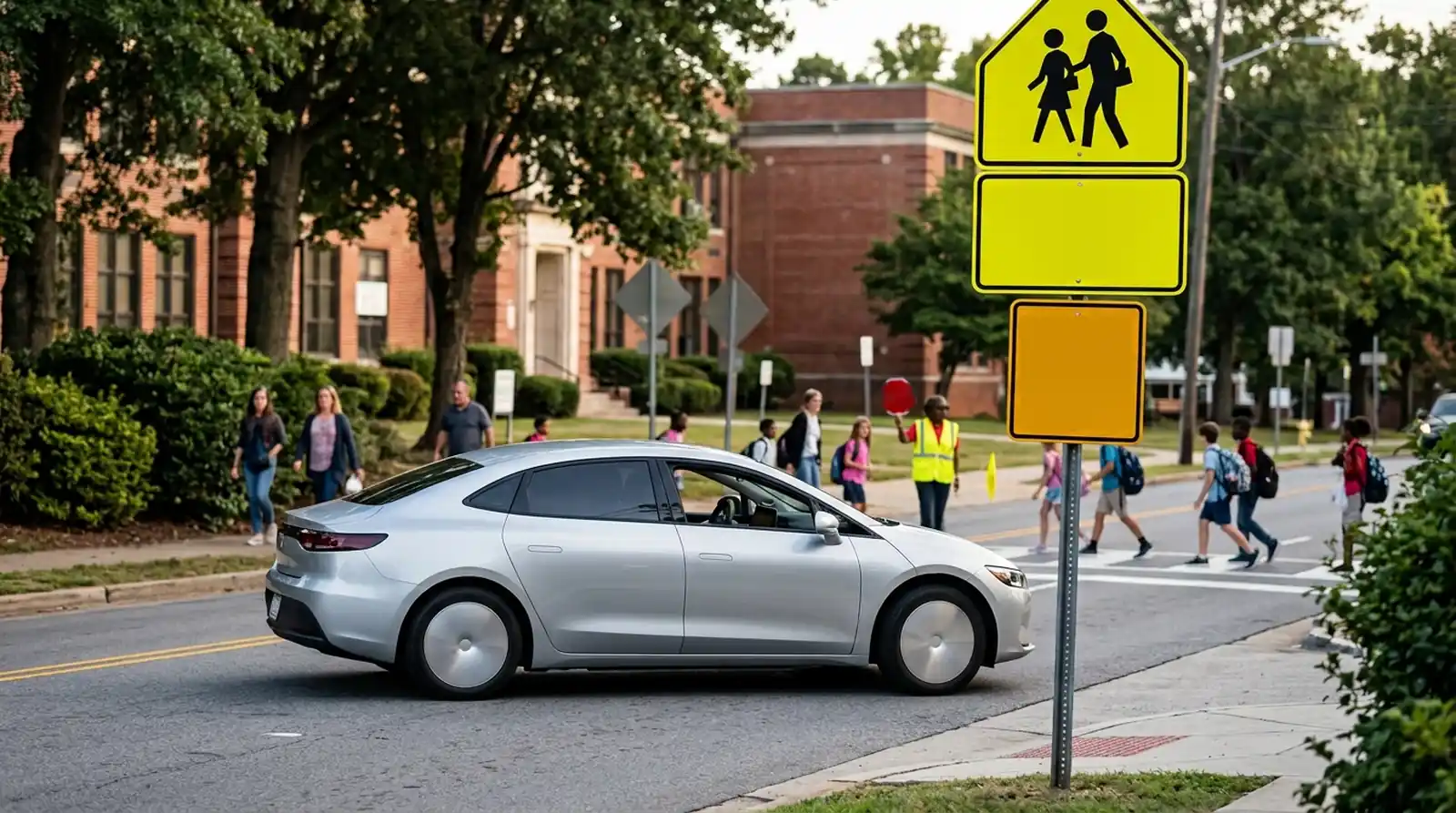
When you’re waiting outside your child’s school, a driverless car passing too quickly is the last thing you want to worry about. The Tesla robotaxi investigation headlines concern a petition review that NHTSA opened on October 9, 2026, over alleged speeding in active school zones. The agency has not opened a formal defect investigation or announced a recall, and its record lists no crashes or injuries.
Before you read further, here are the key facts.
| Item | Detail |
|---|---|
| Action | Defect petition DP26010 |
| Received | September 23, 2026 |
| Opened | October 9, 2026 |
| Vehicles | 2026 Model Y and Cybercab robotaxis operating under automated control |
| Estimated population | 1,000 vehicles |
| Evidence | Three video links and four reports |
| Crashes and injuries | None reported |
| Decision due | Around January 21, 2027, under the 120-day rule |
What the Tesla Robotaxi Investigation Is Really About
If you’re wondering what brought federal regulators into this, the allegation is specific. A petitioner claims Tesla robotaxis traveled faster than the posted limits while school-zone restrictions were active. Here’s what the public record tells you about that request.
NHTSA’s opening document does not identify the petitioner. It lists three video links supporting the allegation and four reports altogether, comprising one complaint submitted to the agency and three additional reports.
That doesn’t mean you’re looking at four verified violations. The agency opened DP26010 to assess the allegations and decide whether further investigation is justified. No defect finding has been announced.
Bloomberg, reporting through Claims Journal, says NHTSA published the documents on October 12. Gizmodo reported the following day that Tesla had not immediately answered its request for comment.
You see, the distinction matters. You have a documented safety allegation and an agency review, while the underlying claim still needs assessment.
Petition Review vs Formal Probe
You might read “investigation” and assume regulators have already established a problem. In this case, they are deciding whether to open the formal investigation requested by the petitioner. To understand the headlines, it helps to separate the stages.
| Stage | What it means | Can it lead to a recall |
|---|---|---|
| Defect petition, or DP | NHTSA assesses a request to investigate an alleged problem | Indirectly, if the request leads to an investigation |
| Preliminary Evaluation, or PE | The agency begins a formal defect investigation | Yes, if the findings support one |
| Engineering Analysis, or EA | A further stage of technical examination | Yes, although a recall is not guaranteed |
| Recall | A safety problem is addressed through a remedy | This is the corrective action itself |
Under federal petition rules, NHTSA must tell the petitioner whether it grants or denies the request within 120 days of receiving it. For DP26010, that points to approximately January 21, 2027.
A denial also requires a Federal Register notice explaining the reasons within 45 days. If the request is granted, ODI opens an investigation.
Should you treat January as a guaranteed finish line? Past timing gives you reason for caution. As The Auto Wire notes, a Tesla sudden-acceleration petition received in December 2019 was denied in a notice published in January 2021.
Where Tesla Robotaxis Run Today
If you’re considering a ride, the service’s location tells you only part of the story. Some vehicles operate without an onboard monitor, while others still carry a person. Here’s how the reported rollout breaks down.
| City | Launched | Safety monitor or driver |
|---|---|---|
| Austin | June 22, 2025 | Initially passenger-seat monitors, with limited unsupervised rides added in January 2026 |
| Dallas | Unsupervised service began April 18, 2026 | Texas operations include monitored and unmonitored vehicles |
| Houston | Unsupervised service began April 18, 2026 | Texas operations include monitored and unmonitored vehicles |
| Miami | July 3, 2026 | Florida operations include monitored and unmonitored vehicles |
| Orlando | July 21, 2026 | Florida operations include monitored and unmonitored vehicles |
| Tampa | July 21, 2026 | Florida operations include monitored and unmonitored vehicles |
| San Francisco Bay Area | Operating by early October 2026 | A safety driver remains onboard |
According to The Chargeport’s tracker, Phoenix and Las Vegas were preparing for service in early October. You should therefore distinguish announced locations from cities already carrying passengers.
Fleet numbers need similar care. Tesla does not publish its total operating fleet, and registrations don’t tell you how many vehicles are accepting rides.
The Chargeport recorded 476 Texas registrations on September 21, including 409 Model Ys and 67 Cybercabs. Cybercab registrations reached 169 by October 2, but you cannot simply add that later figure to the earlier total.
What about the fare? Not a Tesla App reported Austin pricing of $3 plus $1.40 per mile in March 2026, making five miles about $10. October prices were unconfirmed, so check your quote in the app.
The Cybercab Factor Tesla’s robot ambitions go beyond cars, too, as our look at Tesla Optimus Gen-3 shows.
The Cybercab adds another question for you to keep separate from alleged speeding. Its public Austin debut on September 3, 2026, coincided with a different NHTSA review concerning federal safety certification. Here’s why that review matters.
The two-seat vehicle has neither a steering wheel nor pedals. Through audit query AQ26002, NHTSA is examining the process and technical information Tesla used to certify compliance with federal motor vehicle safety standards.
According to Electrek, the agency sought sworn answers, which had not been released publicly. That certification examination does not establish that the school-zone allegation is true.
You may also see comparisons with Amazon’s Zoox. Gizmodo reports that Zoox received a temporary exemption in July 2026 covering up to 2,500 robotaxis annually for two years, after NHTSA accepted its equivalent-safety case.
For you, the useful distinction is simple. DP26010 concerns alleged driving behavior, while AQ26002 concerns how Tesla certified the Cybercab. They address different questions.
Tesla’s Track Record With NHTSA
If these headlines sound familiar, you’ve probably seen earlier scrutiny of Tesla’s driving software. Those cases involve different vehicles and questions, so it helps to keep the records separate.
| Year | Action | Vehicles | Issue |
|---|---|---|---|
| 2023 | Recall 23V-085 | 362,758 vehicles with FSD Beta | Four driving behaviors, including speed control where limits change |
| 2025 | Contact following June launch videos | Austin robotaxis | Footage appeared to show speeding |
| 2025 | Preliminary Evaluation PE25012 | About 2.88 million FSD-equipped cars | Reported traffic violations, including red lights and wrong-way driving |
| 2026 | Engineering Analysis EA26002 | About 3.2 million FSD-equipped cars | Crashes involving glare and other conditions that reduce what cameras can see |
| 2026 | Audit Query AQ26002 | Cybercab | Federal safety certification |
| 2026 | Defect petition DP26010 | An estimated 1,000 robotaxis | Alleged speeding during school-zone restrictions |
The 2023 recall involved a wireless software update. According to The Auto Wire, Tesla disputed NHTSA’s analysis, although it proceeded with the remedy.
For you, the distinction is responsibility. Privately owned cars using FSD Supervised still require a responsible driver, while this petition concerns robotaxis operating under automated control.
What Waymo’s School Bus Recall Suggests
Could a school-related driving problem lead to a software recall? Waymo’s experience shows that it can, though you shouldn’t assume Tesla will face the same outcome. Here’s the relevant precedent.
Waymo’s recall 25E084 covered 3,067 vehicles after concerns about passing stopped school buses. Electrek reports that Austin ISD recorded about 20 such incidents, while The Auto Wire says the remedy was delivered through software.
Separately, NHTSA opened an investigation after a Waymo vehicle struck a child close to a Santa Monica elementary school. These are different events, but they give you examples of school-related incidents receiving federal scrutiny.
What Could Happen Next
You’re still waiting for NHTSA’s decision on whether the petition justifies a formal investigation. Several outcomes remain possible, and the next announcement should tell you which path the agency takes.
- Petition granted. ODI would open an investigation. A later defect finding could lead to a recall, with a wireless software remedy among the possible outcomes.
- Petition denied. NHTSA would publish its reasons in the Federal Register. That would explain why the requested investigation was declined.
- State action. Texas DMV can restrict or suspend an autonomous-vehicle authorization when operation is unsafe. You should distinguish that authority from the federal petition process.
- Company update. Tesla’s October 21 earnings announcement is another date to watch. It may provide service updates, although you shouldn’t assume the company will address DP26010.
Who Gets the Ticket When a Robotaxi Speeds
If there’s nobody behind the wheel, who receives the citation? The answer depends on state law, and California uses a different reporting mechanism from the rules described in Texas and Florida.
- Texas. When automated driving is engaged, the system is legally treated as the operator. Any citation goes to the owner or permit holder.
- Florida. The engaged system is likewise treated as the operator. For speeds more than 10 mph above the limit during the specified 30-minute periods around school opening and closing, the registered owner receives the school-zone camera notice.
- California. Since July 1, 2026, police can issue an autonomous-vehicle noncompliance notice. It carries no fine and must be reported to the DMV within 72 hours.
Advice for Parents and Riders
You don’t need to wait for a federal decision to report something concerning. Whether you’re outside a school or inside a robotaxi, useful details can help an agency assess what happened. Here’s what you can do.
For parents near schools
Treat a robotaxi with the same caution you would give any passing vehicle. If you observe suspected speeding, note the time, exact location and license plate, and retain any available video.
For robotaxi riders
You cannot select the robotaxi’s speed policy as an owner might select an FSD speed profile. Report concerning behavior through Tesla’s app and submit a vehicle-safety complaint to NHTSA.
How to report a robotaxi incident to NHTSA
- Open nhtsa.gov/report-a-safety-problem.
- Describe when and where it happened, identifying the vehicle as clearly as you can.
- Include relevant video and explain the behavior you observed.
- If you prefer to call, use NHTSA’s hotline at 888-327-4236.
The Road Ahead for Tesla’s Driverless Fleet Other EV makers are betting on robots in different ways, from Rivian’s Mind Robotics spinoff to leasing models like Ultra Robotics.
For now, you have an allegation under review, with no crashes or injuries recorded in DP26010 and no recall announced. The 120-day rule points to a decision around late January 2027, although past petitions show that timing can slip.
Keep an eye on the agency’s next filing, and report specific incidents if you witness them. That gives you something firmer to work with than a headline alone.
FAQs
You can find Tesla’s service in seven metropolitan areas according to early October tracking, although onboard supervision varies. Those areas include Austin, Dallas, Houston, Miami, Orlando, Tampa and the San Francisco Bay Area. Tesla has not disclosed a complete operating fleet count.
No, you’re currently looking at an assessment of a petition asking NHTSA to investigate alleged school-zone speeding. DP26010 allows the agency to examine that request before accepting or rejecting it. It is neither a Preliminary Evaluation nor a defect finding.
You’ll see an agency estimate of 1,000 vehicles, covering 2026 Model Y and Cybercab robotaxis when their automated driving system is operating. That estimate should not be treated as a verified count of cars carrying passengers. Tesla does not publish that total.
Yes, you could eventually see a recall if further investigation supports corrective action. NHTSA would first need to grant the petition and open an investigation. Previous Tesla and Waymo software remedies show that a recall can involve an update rather than a physical repair.
Yes, you may still encounter a Tesla robotaxi with a human monitor onboard. The Chargeport reports both monitored and unmonitored operations in Texas and Florida, while Bay Area vehicles retain a safety driver. Tesla has not published the numerical split.
You can submit a complaint through NHTSA’s vehicle-safety reporting page or call 888-327-4236. Give the date, time, road location and identifying vehicle details, adding video if you have it. Explain what you observed without presenting an estimated speed as a measured one.
