

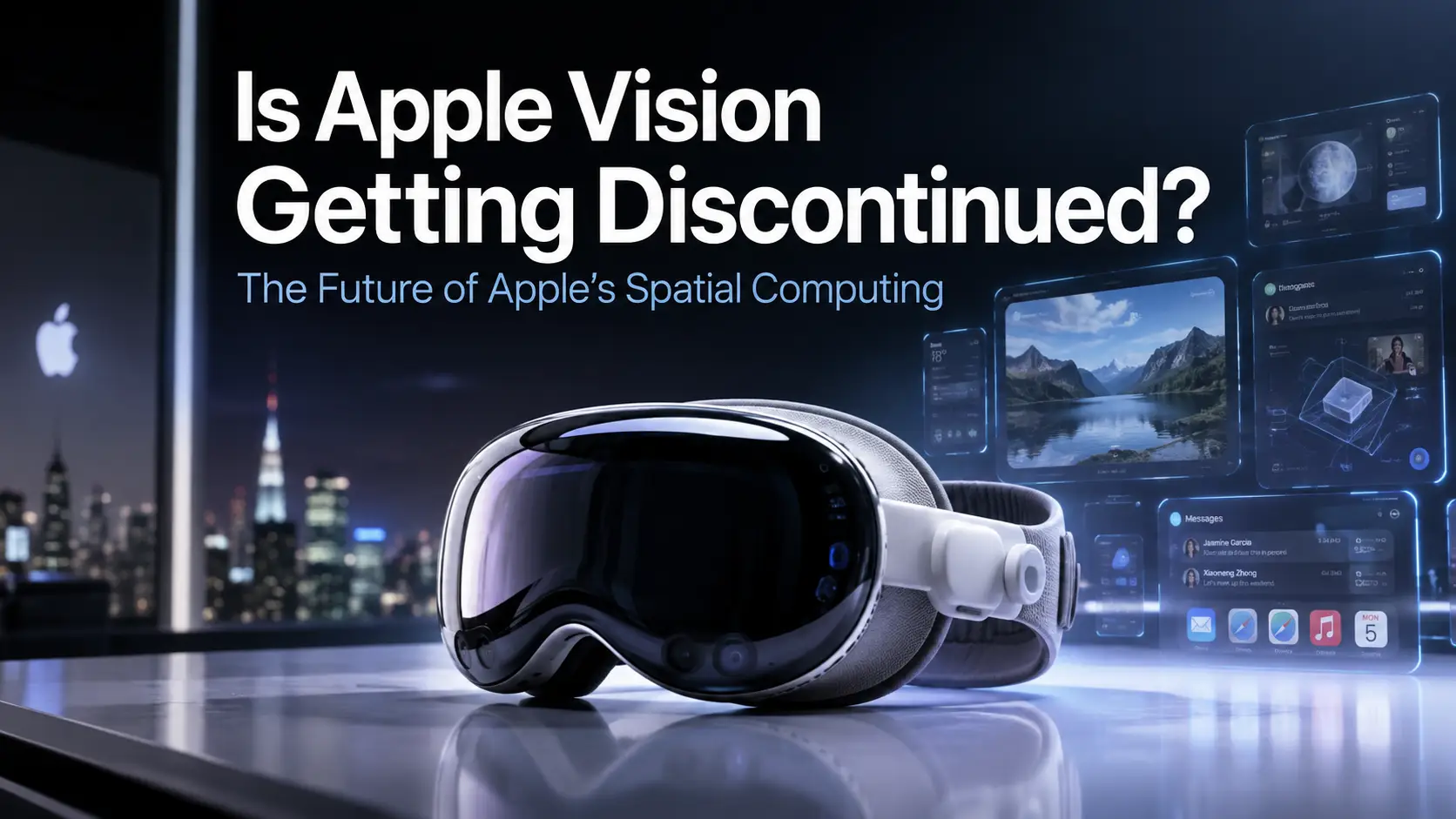
The start of 2026 has brought a wave of reports regarding the end of the Apple Vision Pro line. Many people are looking at the headlines and wondering if the era of spatial computing from Apple has already reached its conclusion. You might see discussions suggesting that the hardware is being pulled from shelves, but the reality is more nuanced than a simple cancellation of a product.
The central question is whether Apple is walking away from the entire category or simply changing the way the technology looks and feels. When you look at the recent internal reports, it seems the company is moving toward a different style of wearable. The focus appears to be moving from heavy goggles to something that fits more naturally into your daily life without drawing as much attention.
This article provides an analysis of the production reports, the projects that were reportedly stopped, and the strategic move toward lightweight augmented reality. You will see how the lessons from the first generation are guiding the next decade of Apple’s wearable technology. By understanding the reasons behind these changes, you can better predict what will replace the current headset in the coming years.
The Current State of the Apple Vision Lineup
The most recent hardware update arrived in late 2025 when Apple introduced the M5 chip to the Vision Pro. This refresh also brought a 120Hz display, which made the visual experience much smoother and more responsive for those using the device for professional work. While the technical specs were impressive, they did not change the core experience enough to attract a wider audience of buyers.
The market reception for this updated model remained quiet as the high cost and bulky design continued to limit interest. Many consumers expected a more affordable version or a lighter design, and the M5 update did not address those physical concerns. As a result, the device remained a niche product for tech enthusiasts and specific professional groups rather than a common household item.
Sales data from the final months of 2025 showed a clear decline in consumer interest, with reports indicating that unit sales dropped below 45,000 for the quarter. This number is quite low for a company used to selling millions of iPhones and iPads in similar timeframes. This drop in volume is what sparked the current discussions about whether the product line has a viable future in its current form.
Despite the rumors and the low sales figures, the Vision Pro remains officially available for purchase on the Apple storefront. You can still buy the M5 model today, and the company has not issued any statements regarding a total withdrawal from the market. For now, the hardware exists as a current product, even if the manufacturing plans for future versions are being reconsidered.
Why Rumors Suggest a Production Halt
Manufacturing reports from the supply chain indicate that assembly lines are moving much slower than they were at launch. Luxshare, the primary partner responsible for building the headset, has reportedly scaled back its operations or paused certain lines entirely. When a company stops making new units at a high rate, it usually means they have enough stock to meet current demand for a long time.
High return rates and a lack of new buyers have led to a large inventory of unsold units sitting in warehouses. When you look at the economics of the device, it becomes clear that Apple does not need to keep production running 24/7 if the existing stock can last through the next year. This backlog is a strong signal that the company is reevaluating how much hardware it needs to have on hand.
A production halt does not mean that the device is dead for those who already own one. In the technology world, companies often stop making a device while continuing to provide software updates and repair services for several years. This transition usually means that the focus has moved to a new project or that the current hardware has reached the end of its intended manufacturing cycle.
There are also reports that Apple is moving its supply of high-end micro-OLED components to other projects that are currently hidden from the public. These specialized screens are expensive and difficult to make, so using them for a product with low sales is not efficient. By moving these parts to new prototypes, the company can continue to develop visual technology without wasting resources on the original headset design.
Analyzing the Canceled Vision Roadmap
The plans for future hardware have taken a sharp turn according to internal reports. Below are the details regarding the projects that are no longer moving forward.
The Fate of Vision Pro 2
Development for a direct successor to the high-end Pro model has reportedly stopped. While engineers were working on a version that would be more powerful, the lack of interest in the current $3,499 price point made a second premium version hard to justify. Apple appears to have realized that making a slightly better version of a very expensive device would not solve the core problem of low adoption.
The resources that were supposed to go into the Vision Pro 2 are now being utilized for other types of wearable technology. You will likely not see another “Pro” headset in this specific style for several years, if ever. The company is prioritizing designs that people are more willing to wear in public spaces and for longer periods during the day.
This change in the roadmap suggests that the “Pro” label might have been too ambitious for a first-generation product. Instead of trying to force a second version into a market that is not ready, Apple is stepping back to rethink the hardware. This pause allows them to wait for better technology that could make a future headset much smaller and more efficient.
The Vanishing “Vision Air”
There were many rumors about a cheaper and lighter model often referred to as the “Vision Air.” This version was meant to bring the price down by using less expensive materials and moving some of the processing to the iPhone. However, reports suggest this project was also removed from the official roadmap because it still could not reach a price or weight that would appeal to the general public.
The challenge was that even a cheaper version of the goggles still felt like goggles to the person wearing them. Apple found that reducing the price did not fix the social and physical discomfort that users reported. If the device was still too heavy to wear for an entire workday, a lower price tag was not going to be enough to make it a success.
Without the “Air” model, the gap between the expensive Pro headset and a mass-market device remains wide. This gap is likely why the company is looking at smart glasses instead of trying to make a medium-sized headset. They are moving past the idea of a “middle” device and focusing on something entirely different.
Team Redistribution
Engineers who were once dedicated to the Vision hardware are now moving to other parts of the company. A large number of these employees have joined the Siri and artificial intelligence departments. This move shows that Apple wants to prioritize the software and intelligence that will run on future devices rather than focusing on the headset hardware itself.
By moving these experts, the company can improve how you interact with your devices using your voice and eyes. The work done on the Vision Pro is not being wasted; it is being used to make Siri more capable of understanding what you are looking at and what you need. This internal reorganization is a strong indicator that the company’s priorities have changed.
The hardware team is now smaller and more focused on long-term research rather than immediate product launches. You can expect the remaining members to work on the optical technology and sensors that will eventually fit into standard glasses. The era of the massive “Vision Team” as a standalone hardware unit appears to have ended.
Software-Only Focus
There is some discussion that Apple might eventually treat visionOS as a platform that could run on other companies’ hardware. While this seems unlikely given Apple’s history of controlling both software and hardware, it is a topic of conversation among analysts. If they cannot make the hardware profitable, they might focus on making the operating system the standard for spatial computing.
For now, the focus remains on keeping the software alive for the existing Vision Pro users and developers. You will see continued updates to the operating system that improve the way windows and apps work in a 3D space. This keeps the ecosystem ready for whenever the next generation of hardware finally arrives in a different form.
Maintaining the software allows Apple to keep developers interested in building spatial apps. If the company stopped updating the OS, the entire ecosystem would disappear quickly. By keeping visionOS active, they ensure that when they launch smart glasses, there will already be thousands of apps ready to go.
Supply Chain Pivot
Apple’s relationship with specialized lens and sensor manufacturers is changing to focus on smaller components. The massive lenses used in the Vision Pro are not what the company needs for the future. Instead, they are asking partners to develop tiny projectors and thin lenses that can fit inside the frame of a normal pair of glasses.
This change in orders tells the story of where the company is going. When you look at the supply chain, you can see that the demand for bulky headset parts is falling while the demand for miniaturized AR components is growing. This is a clear sign that the manufacturing focus has moved toward a more portable future.
The companies that make the micro-OLED displays are also being told to focus on brightness and power efficiency for outdoor use. The current displays are great for indoors, but smart glasses need to work in the sun. This change in technical requirements is another piece of evidence for the move away from the original goggles.
The Strategic Pivot to Smart Glasses
Apple is changing its strategy to favor wearable designs that look like traditional glasses. The following developments show where the company is putting its resources.
Moving Away from “The Goggles”
The most obvious change is the move away from the “ski mask” look that defined the Vision Pro. While the technology inside was impressive, the physical appearance was a barrier for almost everyone. People generally do not want to wear a heavy device that covers their face and makes them feel separated from the world.
Apple has realized that for a wearable to be successful, it needs to be socially acceptable. This means the hardware needs to look like something people already wear every day. The focus is now on making the technology disappear into a frame that looks like a standard pair of glasses.
By moving away from the goggles, the company is admitting that immersion is less important than comfort. Most people would rather have a few digital features in a light device than a full virtual reality experience in a heavy one. This is a major change in how Apple thinks about spatial computing.
The AI Smart Glasses (Target 2027)
A new project is reportedly aiming for a 2027 release that will compete directly with the smart glasses made by Meta and Ray-Ban. These glasses will likely not have a screen at all, focusing instead on cameras, microphones, and speakers. You would use them to talk to an AI assistant that can see what you see and give you information through audio.
These glasses are much easier to build and much cheaper to sell than a full headset. They solve the problem of weight and battery life because they do not have to power high-resolution displays. For many people, a pair of glasses that can identify objects or translate text through audio is more useful than a heavy VR headset.
This product will act as a bridge between the iPhone and the future of augmented reality. It allows Apple to get people used to wearing cameras on their faces without the complexity of a 3D interface. It is a more practical way to bring spatial intelligence to the mass market.
True AR Glasses (Target 2029)
The long-term goal for the company is a product often called “Apple Glass,” which is expected around 2029. These would be true augmented reality glasses that use transparent lenses to show digital images in the real world. Unlike the Vision Pro, which uses cameras to show you a video of the room, these would let you see through the glass directly.
This technology is very difficult to create because it requires tiny projectors that are powerful enough to be seen in daylight. Apple is spending a lot of money on research to make these lenses thin and light enough for all-day wear. This is the ultimate version of the vision that started with the Vision Pro.
When these glasses arrive, they will likely replace many of the functions of the iPhone. You would see your messages, directions, and apps floating in front of you while you walk. This is the “spatial computing” future that Apple still believes in, even if the first headset was not the right way to get there.
Integration with Apple Intelligence
The next generation of wearables will put “Apple Intelligence” at the center of the experience. Instead of focusing on immersive movies or games, the glasses will focus on helping you get through your day. You might ask Siri what kind of plant you are looking at or for the name of the person walking toward you in a meeting.
This focus on AI makes the device much more useful in real-world situations. The Vision Pro was mostly a device for sitting on a couch or at a desk, but AI glasses are meant for being out in the world. This moves the technology from an entertainment tool to a personal assistant.
By prioritizing Siri, Apple can make the hardware simpler. The heavy lifting is done by the AI models running on the device or in the cloud, rather than by a massive processor sitting on your face. This helps keep the glasses light and the battery life long enough to last a full day.
Portability vs. Immersion
Apple has learned that users value portability over high-fidelity immersion. While the Vision Pro has the best screens in the world, most people find them less valuable than a device they can actually carry around. The realization is that a device you use for ten minutes is less important than a device you wear for ten hours.
This change in philosophy means that future products will not try to recreate a movie theater on your face. Instead, they will try to give you helpful bits of information when you need them. This “glanceable” information is what made the Apple Watch a success, and the company is applying that same logic to glasses.
You will likely see a future where the Vision Pro is remembered as a powerful tool for developers, while the glasses become the product that everyone actually uses. The goal is no longer to replace your reality, but to add a small layer of intelligence to it. This is a more realistic and popular path forward.
5 Major Obstacles That Hindered Vision Pro’s Success
Several factors contributed to the slow adoption of the first spatial computer. Below are the primary reasons why the device struggled to reach a wide audience.
The “Luxury” Price Barrier
The $3,499 price tag was the most significant reason the device stayed out of the hands of average consumers. Even for people who love technology, spending the cost of two high-end laptops on a single headset is a difficult choice. This price meant that the device was viewed as a luxury item for the wealthy rather than a tool for everyone.
Apple is known for premium pricing, but the Vision Pro pushed that to a level that few could justify. Without a clear financial reason to own one, most people decided to wait for the technology to get cheaper. The high cost also made people more critical of any small flaws they found in the device.
When you pay that much for a product, you expect it to be perfect and to replace multiple other devices. Since the Vision Pro still required an iPhone or a Mac for many tasks, it felt like an expensive addition rather than a replacement. This pricing strategy limited the user base to a very small group of early adopters.
The Weight and Comfort Struggle
The physical toll of wearing a 1.3-pound device on your face cannot be ignored. Even with the introduction of new headbands and light seals, the weight remained a major complaint for almost every user. Most people found that after an hour of use, their neck or face would begin to feel the strain.
This lack of comfort meant that people did not use the device as much as Apple had hoped. If a device is uncomfortable, you are less likely to pick it up for a quick task or a long work session. The ergonomics of the “goggle” design reached a limit that current materials could not overcome.
Technology can improve quickly, but human biology does not change. A device that causes physical fatigue will always face an uphill battle for popularity. Apple’s focus on the M5 chip didn’t matter to users whose main problem was the weight of the glass and metal on their nose.
The Search for a “Killer App”
Even after a year on the market, the Vision Pro lacked a “must-have” software experience that could not be found elsewhere. You can watch movies in a virtual theater, but you can also watch them on a high-end TV. You can work on multiple windows, but a Mac with a large monitor often feels more productive.
The lack of a unique reason to use the device every day made it hard for people to build a habit around it. Developers were hesitant to build complex apps for a device with such a small number of users, and users were hesitant to buy the device because there were not enough apps. This cycle prevented the device from finding its true purpose.
For a new platform to succeed, it needs to do something that is impossible on a phone or a laptop. While spatial photos and videos are impressive, they were not enough to convince millions of people to change how they live. The search for a killer app continues, but it will likely happen on a different form factor.
Battery Life Constraints
The inconvenience of an external battery pack connected by a wire was a constant reminder of the technology’s limitations. You could not simply put the headset on and walk around freely without thinking about the cable. Furthermore, the two-hour battery life meant that you were almost always tethered to a wall outlet for longer tasks.
This limited mobility took away from the “spatial” freedom that the device promised. If you have to sit near a power source, the device is not much more portable than a desktop computer. The external battery was a necessary compromise, but it was one that many users found frustrating.
Future wearables will need to find a way to hide the battery or make it last much longer without adding weight. The Vision Pro showed that the current state of battery technology is not quite ready for high-performance spatial computing. This is one of the biggest technical challenges Apple is working to solve before the next launch.
The Social Isolation Factor
There is a psychological barrier to wearing a device that covers your eyes while you are around other people. Even with the “EyeSight” feature that shows a digital version of your eyes, the device feels like a wall between you and the world. In a social or professional setting, this creates a sense of isolation that many find uncomfortable.
Apple tried to market the device as something you could use while staying connected to your surroundings, but the reality felt different. When you wear the Vision Pro, you are in your own digital world, and the people around you are just part of a video feed. This feeling of being “removed” from the room is a major reason why people are hesitant to use it in public.
For a device to become part of daily life, it needs to be social. This is why the pivot to glasses is so important. Glasses allow you to maintain eye contact and stay present in the room while still having access to digital information. The isolation of the headset is perhaps its biggest design flaw.
Apple’s Official Response and Long-Term Vision
Despite the reports of a production halt, Apple executives continue to speak about the platform in positive terms. CFO Kevan Parekh has mentioned that the company looks at the “ecosystem value” of the Vision Pro rather than just the number of units sold. From this perspective, the device is a success if it helps Apple learn how to build the next generation of software and services.
Tim Cook has consistently referred to the Vision Pro as a “pioneer” device. This language suggests that Apple never expected it to be a massive hit like the iPhone right away. They see it as a way to get the hardware into the hands of developers so they can start experimenting with what is possible in a 3D environment.
The company also points to the frequent updates for visionOS as proof of their commitment. They are still working on features like better Mac mirroring and improved hand tracking to make the current device more useful. This ongoing support shows that they do not want to leave current owners behind even as they look toward new hardware designs.
The strategy here is a “long game” that mirrors the early days of the Apple Watch. That product also struggled at first with a high price and a lack of clear purpose, but it eventually found its place as a health and fitness tool. Apple is betting that spatial computing will follow a similar path, even if it takes a decade to reach its full potential.
How Apple Vision Pro Competes With the Market
Meta continues to lead the market with the Quest 3 and Quest Pro, which are significantly cheaper than Apple’s offering. By focusing on gaming and social experiences at a lower price, Meta has managed to reach a much larger audience. This pressure from the competition forced Apple to justify why its device cost so much more, and for many, the answer was not clear enough.
In the enterprise space, the Vision Pro has found a small but stable niche in specialized fields like surgery and high-end engineering. These professionals value the incredibly high resolution and precise tracking for tasks where accuracy is more important than comfort or price. This success in “niche” markets shows that the technology itself is world-class, even if it is not ready for the general public.
Technologically, Apple still holds a lead over its competitors when it comes to display quality and eye-tracking. No other consumer headset offers the same level of visual clarity or the “magic” feeling of selecting items just by looking at them. While sales are low, the Vision Pro remains the gold standard that other companies are trying to reach with their own hardware.
What This Means for Current Vision Pro Owners
If you already own a Vision Pro, you can likely expect software support to continue for several years. Apple has a history of supporting its platforms long after the hardware has been updated or replaced. Your headset will likely receive visionOS updates that bring new features and security fixes, even if there is no “Version 2” on the horizon.
The resale value of the device will probably be impacted by the rumors of discontinuation. In the second-hand market, products that are seen as “the end of a line” can sometimes lose value quickly as people move on to the next big thing. However, because it is a unique piece of Apple history, it might also become a collector’s item for those who value the first generation of spatial computing.
Your headset will continue to be a powerful tool for the Apple ecosystem, especially when paired with the latest Macs and iPhones. Features like high-resolution mirroring and the ability to view spatial content from your iPhone 17 will keep the device relevant for a long time. It will remain a high-end way to experience the Apple world, even as the company moves toward smaller glasses.
The Final Verdict: Is It Dead or Just Evolving?
The “death” of the Vision Pro is not the end of Apple’s work in this space, but rather a transition in the form factor. The goggles as we know them are likely a temporary step toward a future that is much more portable. You should see this period as an evolution where the company takes what it learned from a bulky headset and shrinks it down into something wearable.
In the short term, the Vision Pro will likely become a niche tool for developers and professionals rather than a mainstream success. It will serve as a laboratory where the best ideas for spatial computing are tested before they are moved to smart glasses. This makes the device a bridge to the future rather than a destination on its own.
The lessons learned from the weight, price, and social challenges of the Vision Pro are essential for Apple’s next decade. By failing in these specific areas, the company now knows exactly what it needs to fix to make a product that billions of people will actually use. The future of Apple’s spatial computing is not dead; it is simply getting ready to look a lot more like a pair of glasses.
