




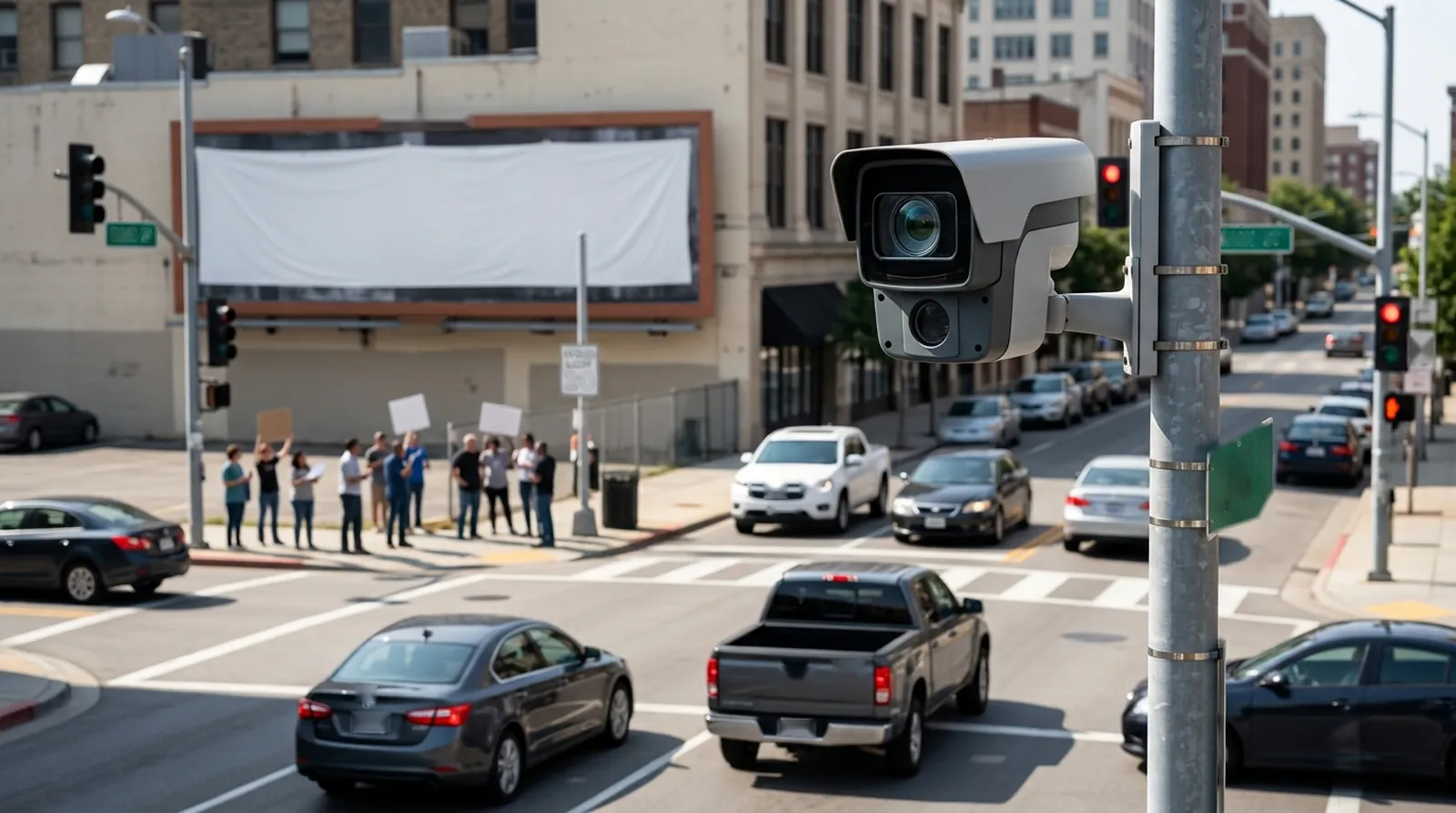
You drive past a roadside camera, and your car becomes searchable even if you have done nothing wrong. Flock cameras are automatic license plate readers that record your plate, vehicle details, and where and when you passed, giving police records they can search. Supporters say that helps solve crimes, while critics warn it allows authorities to trace everyday travel without a warrant.
That disagreement followed CEO Garrett Langley to TechCrunch Disrupt on October 14, 2026, where he spoke as protesters gathered outside. Before getting into his defense, here are the key facts.
| Item | Detail |
|---|---|
| Company | Atlanta-based Flock Safety, established in 2017 |
| Recorded information | License plate, vehicle features, timestamp and location |
| Default retention | Seven days, previously 30, with exceptions |
| Facial recognition | Flock says its technology does not use it |
| Camera count | Company figures put it above 80,000; the ACLU estimates roughly 120,000 |
| Customers | Around 6,000, approximately 60% police and 40% businesses |
| Latest developments | October 14 CEO appearance; roughly 18% staff reduction reported |
What Flock Cameras Are and How They Work
Your car does not need to be connected to an investigation to enter the database. When you pass a reader, it creates what Flock calls a “vehicle event,” rather than giving customers a continuous video stream from that license plate camera. Here is what goes into that record.
- Plate information. The registration characters captured as you pass.
- Vehicle features. Details such as manufacturer, model and paint color.
- Travel direction. Which way your vehicle was moving.
- Time and location. When the camera recorded you and where it happened.
According to Flock, each lookup requires a recorded explanation and remains associated with the person who performed it. Customers decide how their records are shared, while the National LPR Network supports alerts between participating agencies.
You see, the privacy question goes beyond an individual camera. It includes how records from different places become accessible to other departments.
More Than License Plates
If you hear “Flock” and think only of roadside plate readers, you are missing several other products. Its range includes video equipment, microphones and drones, so it helps to separate what each tool does.
| Product | What it does |
|---|---|
| Video cameras | Provide video alongside the company’s plate-reading equipment |
| Audio Detection | Identifies gunfire and certain other sounds, according to Flock |
| Drones | Offered for first-response work |
| FreeForm | Lets users search video and plate records using everyday language |
| National LPR Network | Supports alert sharing between partner agencies |
| Flock911 | Another offering listed within Flock’s public safety product range |
What Flock’s CEO Said at TechCrunch Disrupt
At Disrupt, Langley faced questions about both product capabilities and customer conduct. For you, two parts of that conversation help explain why the disagreement continues.
The “just gunshots” claim
Langley described the microphones as detecting gunfire alone, according to TechCrunch. Yet the company’s website listed additional events, including fireworks, serious collisions and vehicle sideshows. That leaves you with conflicting descriptions of what the equipment detects.
A spokesperson subsequently clarified that gunfire is its main purpose, with other supported sound categories. The spokesperson said the system neither listens to conversations nor processes speech, and currently has no scream or distress detection capability.
There is some history here, too. Flock tested a feature advertised around screaming, later described it using human-distress terminology, and ended the pilot in July 2026.
Defending the company
Langley argued that imperfections should not stop useful technology, comparing Flock with autonomous vehicles. He acknowledged errors while saying the tools assist police departments short on personnel. You can see the argument he was making, even if you disagree with it.
According to the reporting, he said Flock recommends policies without requiring cities to adopt them. He blamed much of the criticism on misinformation, politics and social media, including confusion about facial recognition.
Langley also said Flock had never terminated a customer’s contract, though deliberate lawbreaking would justify doing so. Despite earlier reporting about a possible sale, he said he did not want to sell.
Why People Are Pushing Back on Flock Cameras
For you as a driver, the central concern is what happens after your plate enters the system. Privacy groups and published investigations raise questions about access, accuracy and misuse, which fall into three areas.
Privacy and warrantless tracking
The ACLU warns that nationwide searches without warrants can expose visits to clinics, places of worship or demonstrations. It cites an EFF estimate that fewer than 1% of scanned vehicles have a connection to crime, and Business Insider reporting that roughly one in ten Flock reads identifies the wrong state. Your travel records can therefore enter a searchable system without any allegation against you, while errors create another concern.
Federal and ICE access
Flock says it has no contracts with ICE or CBP and stopped federal pilots in August 2025. However, 404 Media reported over 4,000 immigration-related searches performed through local police, showing you why direct contracts are only part of the question.
Mountain View reportedly found federal access it had not known about, while a San Francisco investigation counted 1.6 million accesses from agencies outside California. Flock disputed an Illinois audit’s finding that CBP access violated state law.
Documented misuse cases
You also have to consider how authorized users handle the information. News reports describe these cases and allegations.
- Texas investigation. A sheriff’s office allegedly searched Flock during an abortion-related investigation.
- San Jose officer. An officer was reportedly dismissed over alleged sharing with a relative suspected of domestic violence.
- Wrong accusation. Proton reported that a Columbine Valley woman was wrongly linked to package theft.
- Partner monitoring. Proton also described officers misusing license plate reader systems to follow romantic partners.
Cities That Have Dropped Flock
If your town is debating Flock, you are watching a discussion already happening elsewhere. Straight Arrow News, Fortune and Proton describe cancellations, suspensions and expired agreements, with different circumstances behind each decision.
| City | What happened | Reason given |
|---|---|---|
| Cambridge, Massachusetts | Ended its agreement after two unauthorized installations | City called the installations a contract breach |
| Evanston, Illinois | Issued a cease-and-desist after cameras were reinstalled | Dispute over installation permission |
| Flagstaff, Arizona | Council unanimously voted to end the agreement in December 2025 | Not specified in the report |
| Staunton, Virginia | Ended its six-camera arrangement | City said Langley’s response to critics conflicted with its values |
| Olympia, Washington | Ended an agreement involving 15 cameras | Not specified in the report |
| Mountain View, California | Disabled its cameras | Federal access occurred without the city’s knowledge |
| Santa Cruz, California | Reported among cities ending or suspending agreements | Individual reason not specified |
| Los Angeles, California | Let its agreement expire in July 2026 | Sought tighter control over data |
| Lynnwood, Washington | Voted to end its agreement | Decision followed a review |
The totals need care. The ACLU says more than 200 cities ended agreements with Flock or other plate-reader providers during 2026, so you should not read that as a Flock-only count.
There are separate developments, too. Townhall reports that an October Texas order blocks state grant funding for ALPR agreements, while allowing local funding; Fortune says Ring abandoned its planned Flock connection before activation, with no video transferred.
Flock’s Side of the Story
Flock says its tools help police while placing limits on access and storage. If you want to assess that defense, these are the company’s stated protections and claimed results. Data fights like this are spreading fast, as our look at the Google Spirit Airlines data deal shows.
- Shorter storage. Records normally expire after seven days, although legal requirements, customer rules or investigations can justify longer retention.
- Account security. Flock says users must complete multifactor authentication and that it has expanded auditing and checks for misuse.
- Search accountability. According to Flock, lookups identify the user and include an explanation, creating a record for review.
- Public reporting. Agencies can publish their policies and usage information through transparency portals.
- Ownership and identification. Flock says customers retain ownership, it does not sell their records, and its technology does not perform facial recognition.
- Federal relationships. The company denies having ICE or CBP contracts, though reporting describes access through local departments.
- Claimed benefits. Flock attributes evidence in one-fifth of cleared cases where deployed to its tools and says they helped locate over 10,000 missing people during 2025.
How to Find Flock Cameras Near You
You do not have to rely on spotting a pole during your commute. Public mapping and agency disclosures give you a few places to begin. And if you’re thinking about cameras at your own door, our Ring smart lock and Ring doorbell offline fixes cover the home side of things.
- Check DeFlock. Search your area on its community-maintained map, which uses OpenStreetMap. Remember that contributors add entries, so an empty area does not establish that no cameras exist.
- Recognize the hardware. Typical Flock installations have a dark pole, camera and compact solar panel. Treat appearance as a clue rather than proof of ownership.
- Look for agency disclosures. Check whether your police department publishes a Flock transparency portal, then read its policies and usage figures.
- Request records. If you still need answers, ask the responsible public agency for camera locations and its agreement.
What You Can Do If Flock Cameras Bother You
Finding a camera is one thing; understanding who can use its records takes more work. You can turn that concern into specific questions through these steps.
- Ask for the paperwork. Request contracts, search rules, sharing agreements and audit records through the relevant public records process.
- Contact your council. Raise your questions before a purchase or renewal vote, and attend meetings where camera use is discussed.
- Check other operators. Your neighborhood association or nearby business may use Flock equipment too, so ask about their arrangements.
- Read policy proposals. The ACLU offers a model ALPR bill and local campaign materials that you can compare with your city’s rules.
When you speak with officials, ask questions that call for concrete answers.
- Retention. How long are records kept, and who approves exceptions?
- Access. Which employees and outside agencies can search?
- National searches. Is National Lookup enabled?
- Audits. Who reviews searches, and how is misuse handled?
- New features. Does adding capabilities require public approval?
Where the Flock Camera Debate Stands
You can understand why an understaffed police department wants searchable vehicle records and still question the reach of that system. Flock points to investigative benefits, while privacy groups argue that recording ordinary travel creates risks that individual search logs cannot settle.
Your next step is to check what your own community permits. Watch council decisions, state restrictions and whether shorter storage periods translate into local practice, then use contracts and audit records to test the promises.
FAQs
When you pass a Flock reader, it creates a searchable entry containing your registration and details about the vehicle’s passage. Police can consult those entries during investigations, although the plate-reading camera does not provide customers with continuous video viewing.
Flock says it does not perform facial recognition, while sound detection comes from separate microphone equipment. If your community uses those sensors, the company says they recognize gunfire and certain other events without processing conversations. Its experimental human-distress capability was withdrawn.
Cities have cited concerns about privacy, control over information and unauthorized installations, although their reasons differ. When you see a cancellation total, check whether it includes suspended systems and providers other than Flock.
Yes, published investigations describe federal access and immigration-related searches through state or local police. Flock’s statement that it lacks ICE and CBP agreements therefore does not establish that your local records are inaccessible to federal officials.
Flock’s standard deletion period is seven days, with longer storage allowed in certain circumstances. To understand what applies to your records, check your agency’s policy and any exceptions connected to legal obligations or investigations.
You can start with DeFlock, then compare its entries with disclosures from your police department. For locations or agreements that remain unclear, submit a public records request to the responsible agency.
