

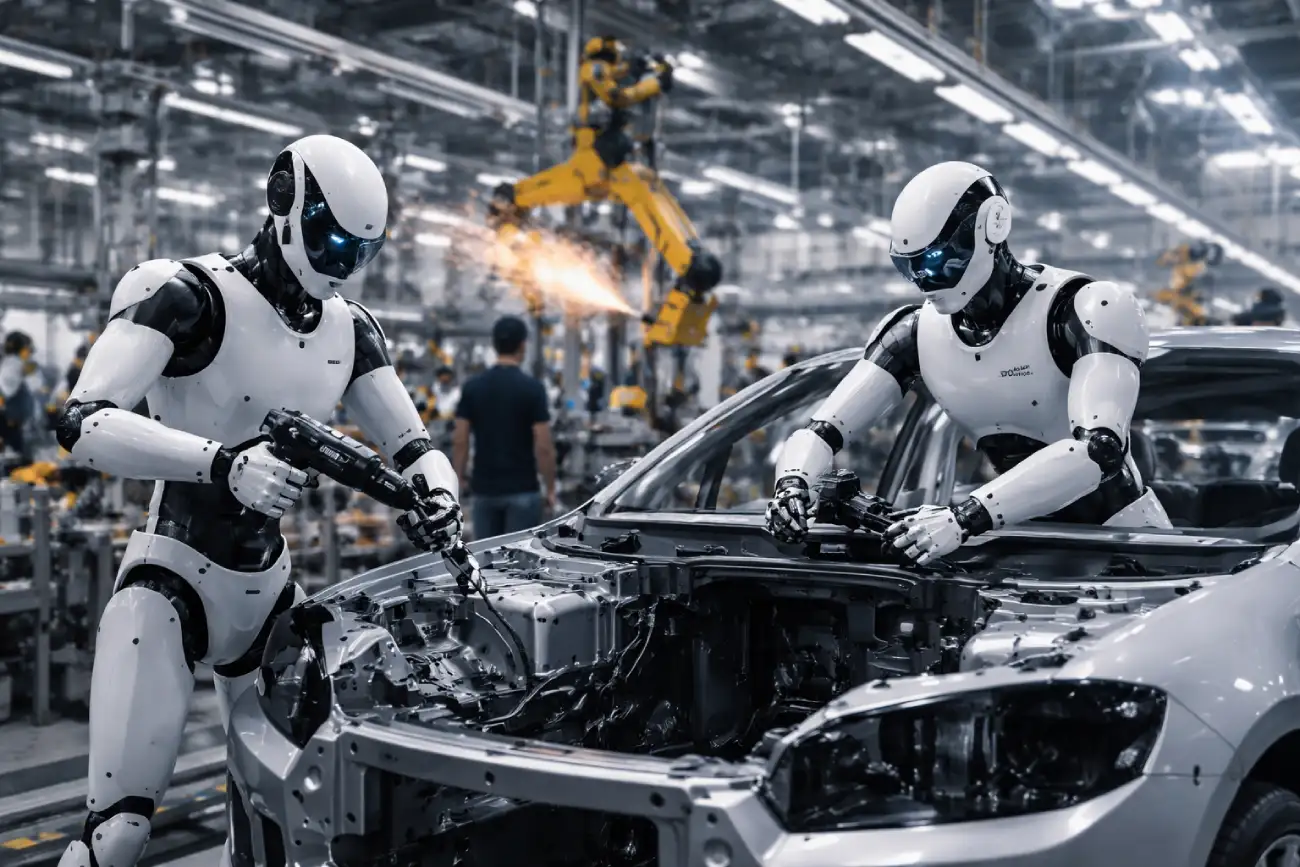
The movement of humanoid robots from quiet laboratories to the active floors of production facilities is a major development in 2026. For years, these machines were experimental subjects, limited to walking across flat surfaces or performing pre-set gestures for cameras. Today, they operate as active participants in vehicle assembly, moving parts and performing tasks that were once reserved for humans. This change shows that the technology has matured enough to handle the heat, noise, and constant movement of a real factory.
Companies like BMW and Xiaomi have adopted the term “internship” to describe these early deployments for a specific reason. It signals that while the robots are capable, they are still in a learning phase where they are closely watched and analyzed. Just as a human intern learns the rules of the shop floor before becoming a full-time employee, these robots are gaining the experience needed to work without constant supervision. Using this language helps manage expectations while these systems refine their ability to handle the unpredictable nature of manufacturing.
The following analysis focuses on how the 2026 pilots of systems like AEON, CyberOne, and Figure 02 are changing the way cars are built. By looking at the successes in Beijing, Spartanburg, and Leipzig, we can see a clear picture of how general-purpose machines are becoming a standard part of the global workforce. This look into the current state of robotics will show why the transition from “intern” to “employee” is the next big step for the industrial world.
Why Humanoid Robots are Entering the Automotive Assembly Line
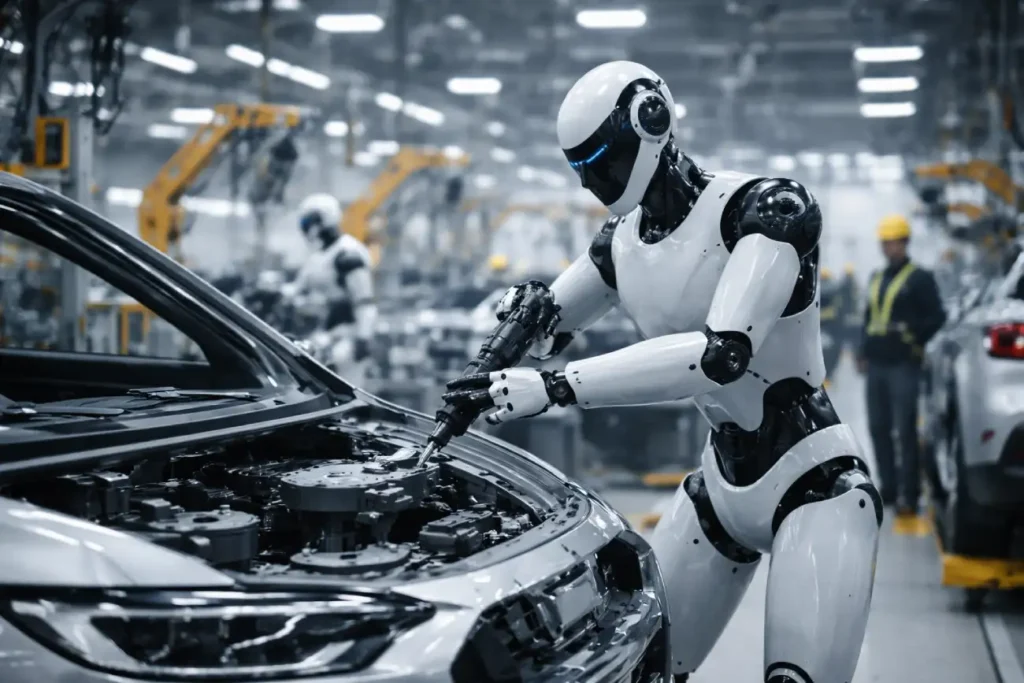
Automotive leaders are facing a new set of pressures that traditional stationary robots cannot solve. The following points explain the main reasons why mobile, human-like machines are now required on the floor.
Addressing Global Labor Shortages
The manufacturing sector is currently facing a major deficit in available workers as older generations retire and leave the workforce. Younger individuals often look for careers in other sectors, leaving many entry-level positions on the assembly line empty for long periods. This gap creates a direct need for systems that can step in and perform routine work without requiring years of human recruitment.
Companies now look to humanoid systems to fill these vacancies because traditional automation is often too rigid for modern needs. When a factory cannot find enough people to manage simple assembly or parts movement, a machine that mimics human movement becomes a practical solution. It helps maintain output levels despite the shrinking pool of human talent available for physical labor.
In 2026, this pressure has reached a point where production lines must adapt or risk slowing down. Humanoid interns provide a way to keep factories running at full capacity even when hiring becomes difficult. By taking on these roles, they ensure that the production of vehicles remains stable and meets the demands of the global market.
Solving Ergonomic Challenges for Human Workers
Human workers often face long-term physical strain from performing repetitive tasks in awkward positions. Lifting heavy components or reaching into tight spaces for hours every day leads to injuries and chronic pain. By introducing robots to these specific areas, companies can protect their people from the most taxing parts of the job.
The humanoid form is especially useful here because it can operate in spaces designed for humans. Instead of rebuilding a whole workstation, a robot can stand where a person once stood and handle the heavy lifting. This allows human workers to move into roles that are less physically demanding and require more mental engagement.
Using robots for these tasks also reduces the number of sick days and disability claims related to workplace strain. As the machines take over the bending, reaching, and lifting, the overall health of the workforce improves. This creates a more sustainable environment where people focus on supervision rather than manual exertion.
Advancing Precision in High-Stakes Assembly
Modern electric vehicles require extreme accuracy during the assembly of batteries and chassis components. A mistake of even a few millimeters can lead to safety issues or hardware failure later in the life of the car. Humanoid robots, equipped with advanced sensors, can maintain this level of precision throughout an entire shift without getting tired.
These machines utilize high-resolution cameras and tactile sensors to ensure every part is placed exactly where it belongs. This consistency is difficult for humans to maintain during a long workday where fatigue can lead to small errors. By using robots for high-stakes assembly, manufacturers can guarantee a higher level of quality for every vehicle that leaves the line.
The ability to repeat a motion with perfect accuracy is the main advantage of these robotic interns. They do not get distracted or lose concentration as the hours pass by. This leads to fewer defects and less waste, which is essential for maintaining the profit margins of a complex EV factory in 2026.
The Versatility of General-Purpose Hardware
Traditional industrial robots are usually fixed in one place and can only perform one specific task, such as welding a single joint. If the product changes, the robot often needs to be replaced or heavily modified. Humanoid robots are different because they are general-purpose tools that can be reprogrammed for various roles as the factory evolves.
This flexibility is vital in an industry where new vehicle models are introduced frequently. A humanoid robot can move from assembling a door to picking parts in a warehouse with only a software update. This means the hardware remains useful for many years, even as the specific tasks on the floor change.
Because they have two arms and can walk or roll through the facility, these robots can use the same tools that humans use. They do not require special adapters or custom-built tracks to move around the shop floor. This versatility makes them a much more valuable investment for a company that needs to stay agile in a competitive market.
Reducing Occupational Hazards
Factories can be dangerous places involving heat, chemicals, and heavy machinery moving at high speeds. Robots are now taking over the roles often described as the “3Ds”: tasks that are dull, dirty, or dangerous. By putting a machine in a high-risk area, the company removes the possibility of a human getting hurt.
In 2026, safety protocols have improved, but some tasks still carry inherent risks that are hard to eliminate. Robots can work in environments with high temperatures or around hazardous materials without the need for complex protective gear. This simplifies the production process while keeping the human staff out of harm’s way.
The goal is to create a workplace where the most dangerous activities are handled by machines that can be repaired or replaced. This move toward robotic safety is a primary driver for the adoption of humanoids in heavy industry. It shows a commitment to using technology to make the factory a better place for the people who manage it.
Xiaomi’s “Factory Internship” in the Beijing EV Plant
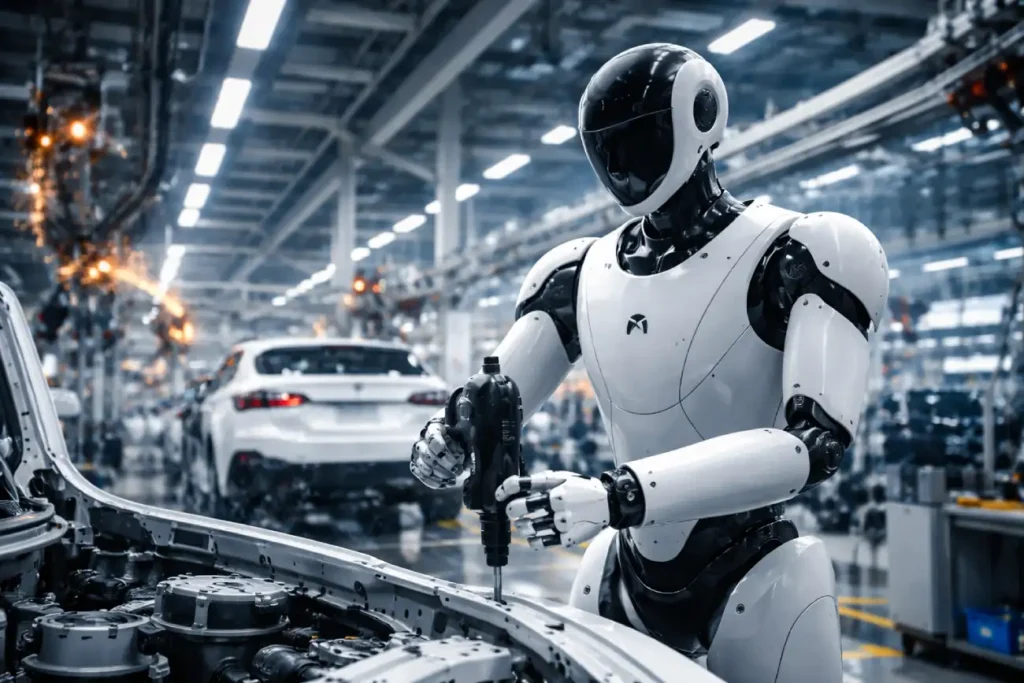
Xiaomi is demonstrating that its expertise in mobile technology and AI is a perfect fit for heavy manufacturing. The Beijing facility serves as a testing ground for their most advanced autonomous systems.
The Role of the CyberOne Humanoid
The CyberOne robot is the lead player in Xiaomi’s push into the electric vehicle manufacturing sector. It was designed to move with a level of fluidity that allows it to navigate the tight spaces of a busy car plant. In 2026, it is no longer just a showpiece but a functioning part of the team in Beijing.
The robot is used to bridge the gap between different stages of production where traditional conveyor belts cannot reach. It can walk between stations, carrying components and interacting with other machines. This mobility is what separates it from the older generation of factory automation that stayed bolted to the floor.
Xiaomi views CyberOne as a platform that will continue to grow in capability as they gather more data from the floor. Each hour it spends in the factory provides information that helps improve its balance and coordination. This makes the robot a living part of the factory’s data ecosystem.
Xiaomi-Robotics-0: The VLA Brain
The intelligence behind Xiaomi’s robots comes from the Robotics-0 model, a system with 4.7 billion parameters. This Vision-Language-Action (VLA) model allows the robot to understand what it sees and translate that into physical movement. It can follow verbal instructions and adapt to new situations without needing a programmer to write new code for every move.
By using such a large model, the robot can recognize thousands of different parts and tools on the fly. It understands the context of its environment, such as knowing to wait when a human worker walks past. This high level of “Physical AI” is what allows the robot to act as an intern rather than a simple machine.
The VLA brain also enables the robot to learn from its mistakes during the shift. If it fails to grip a part correctly, it can adjust its strategy for the next attempt. This ability to learn through experience is a fundamental change in how factory robots are managed in 2026.
Precision Tasks: Nut Assembly and Emblem Application
In the die-casting workshop, Xiaomi’s robots are assigned to specific tasks like self-tapping nut assembly. This requires a steady hand and the ability to align a small part with a hole while the car body is moving. It is a repetitive job that requires constant attention to detail to avoid stripping threads or missing a spot.
Another area of testing involves the application of vehicle emblems, which must be perfectly centered and level. The robot uses its vision system to identify the exact center point of the trunk or hood before pressing the emblem into place. This task demonstrates the robot’s ability to handle delicate items without causing any scratches or damage.
These roles were chosen because they represent the type of fine motor skills that were once thought to be too difficult for robots. By succeeding in these areas, Xiaomi proves that its humanoid hardware has the touch required for final assembly. These “interns” are proving their value in one of the most visible parts of the car.
Performance Metrics: The 90.2% Success Rate
Data from the Beijing plant shows that the robots are performing at a high level during three-hour autonomous shifts. Achieving a 90.2% success rate in nut installation is a significant milestone for a mobile humanoid system. It shows that the robot can handle the vibrations and minor variations found in a real production environment.
While 90.2% is not yet perfect, it is a strong starting point for an “internship” program. The errors are tracked and used to retrain the AI model, meaning the success rate is expected to climb as the pilot continues. This data-driven method allows Xiaomi to measure exactly when the robot is ready for more responsibility.
The company is focused on reaching a level of reliability that matches or exceeds human performance. By analyzing the 9.8% of cases where the robot struggled, engineers can identify hardware or software limits. This transparency is a key part of the pilot’s success in 2026.
Meeting the 76-Second Production Cycle
The most difficult part of working in a modern car factory is keeping up with the speed of the line. Xiaomi’s factory operates on a 76-second cycle, meaning a car moves to the next station every minute and a quarter. If a robot takes 80 seconds to finish its task, it creates a bottleneck that stops the entire plant.
The CyberOne interns have successfully demonstrated that they can complete their assigned tasks within this tight window. This requires them to move with purpose and avoid any wasted motion during the assembly process. Matching the “brisk pace” of the factory is the ultimate test of their practical value.
Staying on schedule also proves that the AI can make decisions quickly enough to keep up with the physical world. There is no time for the robot to “think” or pause for long periods while processing data. The 2026 pilot shows that the gap between robotic speed and human speed is finally closing.
BMW’s Global Pilot: From Spartanburg to Leipzig
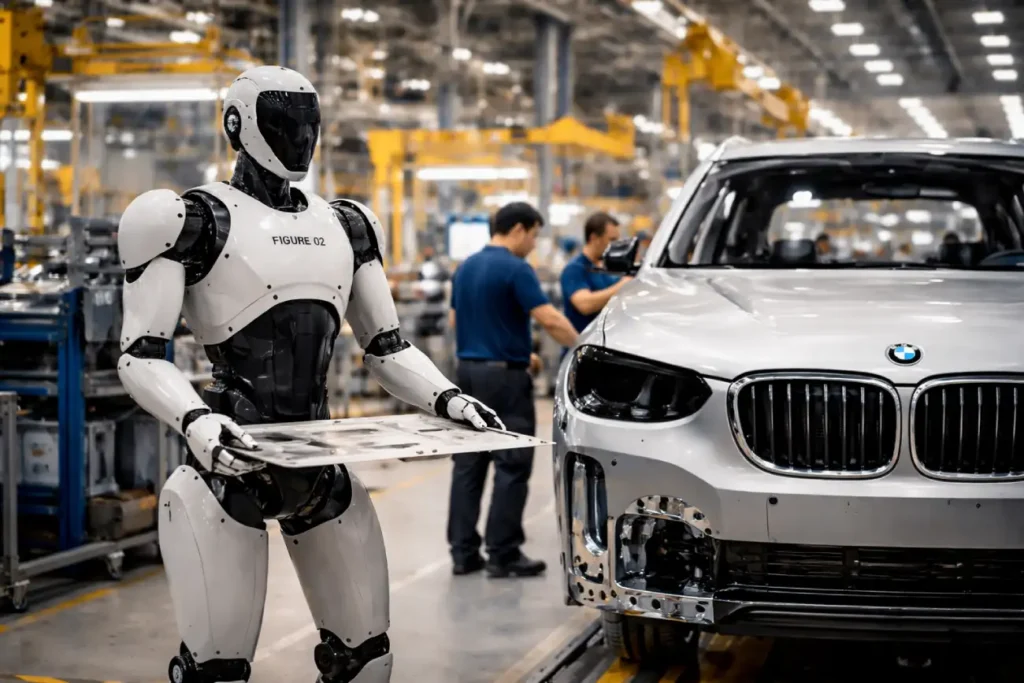
BMW is taking a distributed strategy by running programs across different continents to see how various environments affect performance. These tests provide deep data on how machines handle high-volume production in both the United States and Europe.
The Figure AI Partnership in the USA
In the Spartanburg facility, BMW partnered with Figure AI to test the Figure 02 model over an 11-month period. This collaboration focused on integrating the robot into a facility that is already one of the most productive in the world. The goal was to see if a humanoid could work alongside existing automated systems without causing disruptions.
The Figure 02 robot was tasked with moving sheet metal components, a job that requires both strength and a delicate touch. Because the robot has a human-like frame, it could reach into the same bins and racks that workers use. This meant the factory did not have to be redesigned to accommodate the new “interns.”
The pilot in the USA provided a wealth of information about how robots handle the wear and tear of a full-scale industrial environment. It proved that the hardware could survive thousands of cycles while maintaining its accuracy. This success set the stage for BMW to expand its robotics program to its German facilities.
Milestones: 90,000 Components and 30,000 Vehicles
The statistics from the Spartanburg pilot are impressive, with two robots handling over 90,000 components during the test. These parts were integrated into the assembly of 30,000 BMW X3 vehicles, showing that the robots were doing real work. This was not a small demonstration in a corner of the factory but a true part of the production flow.
By moving such a high volume of parts, the robots covered a distance equivalent to 1.2 million steps. This helped the engineering team understand the durability of the robot’s joints and motors over a long period. It also showed that the AI could handle the variety of parts needed for different vehicle configurations.
These milestones prove that humanoid robots are capable of high-output work in 2026. The data collected from these 30,000 vehicles will help BMW refine its assembly processes for years to come. It serves as a clear indicator that the “internship” phase is producing tangible results for the company.
Introducing the AEON Humanoid in Germany
In early 2026, BMW expanded its efforts by introducing the AEON humanoid to the Leipzig plant. This robot, developed by Hexagon Robotics, represents the next generation of BMW’s physical AI strategy. It was brought in to handle tasks in high-voltage battery assembly and exterior component manufacturing.
The Leipzig plant is a center for EV production, making it the perfect place to test how robots handle sensitive electrical parts. AEON is designed to work in areas where human workers previously needed heavy protective equipment. By using a robot, BMW can streamline these processes and reduce the physical burden on its staff.
This expansion shows that BMW is committed to a multi-platform strategy, using different robot models for different needs. The AEON pilot is scheduled to reach full integration by the summer of 2026. It marks a major step forward for the brand’s European manufacturing footprint.
Hybrid Mobility: Why AEON Uses a Wheels
One of the most interesting design choices for the AEON robot is the use of a wheeled base instead of bipedal legs. While it keeps a humanoid torso and arms for tasks, the wheels allow it to move at speeds of up to 2.5 meters per second. This hybrid design combines the versatility of human arms with the efficiency of a wheeled platform.
In a large factory, the ability to move quickly between stations is often more important than the ability to climb stairs. The wheeled base provides a more stable platform for lifting heavy components, which reduces the risk of the robot tipping over. It is a practical solution for an environment with flat, smooth floors.
This design choice shows that BMW is more interested in utility than in making a robot that looks exactly like a person. In 2026, the industry is moving toward “form follows function,” where the robot’s shape is determined by the job it needs to do. The hybrid AEON is a perfect example of this pragmatic strategy.
Establishing the Center of Competence for Physical AI
To support these efforts, BMW has opened a specialized Center of Competence for Physical AI in Munich. This facility is dedicated to the development and testing of the software that allows robots to interact with the physical world. It serves as a central hub where data from Spartanburg and Leipzig is analyzed and used to improve the fleet.
The center focuses on making robots more autonomous and better at responding to their environment in real time. By centralizing this expertise, BMW can ensure that all its plants benefit from the latest developments in AI. It also allows them to collaborate more closely with hardware partners like Hexagon and Figure AI.
This strategic move shows that BMW sees robotics as a core part of its future, not just a temporary experiment. The center will play a vital role in training the next generation of “robot handlers” who will supervise these systems. It is a foundation for a factory environment where humans and machines work in total sync.
The Technological Evolution: Physical AI and VLA Models
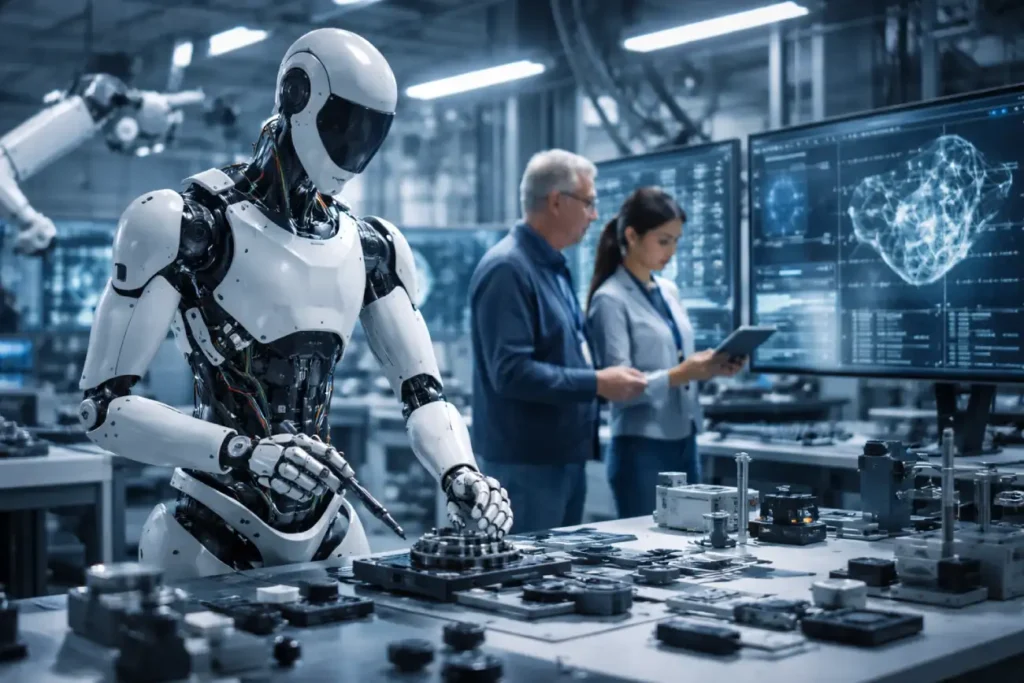
The intelligence of these machines is moving away from pre-programmed scripts and toward a system that learns through interaction. Physical AI allows a robot to understand the laws of physics, such as gravity and friction, as it moves through the factory. This means that if a part is slightly out of place, the robot can feel the resistance and adjust its grip automatically.
Imitation learning is another major part of this evolution, where robots “watch” human workers to learn complex movements. By analyzing video of a person performing a task, the AI can map those motions to its own mechanical joints. This speeds up the training process because the robot does not need to be manually programmed for every single millimeter of movement.
Tactile feedback is also becoming more advanced in 2026, giving robots “sensor-rich” hands that can feel the texture and weight of an object. This is essential for handling delicate automotive components like glass or thin plastic emblems without causing damage. When a robot can feel how much pressure it is applying, it becomes much more reliable for final assembly tasks.
Comparing the Xiaomi and BMW Deployment Strategies
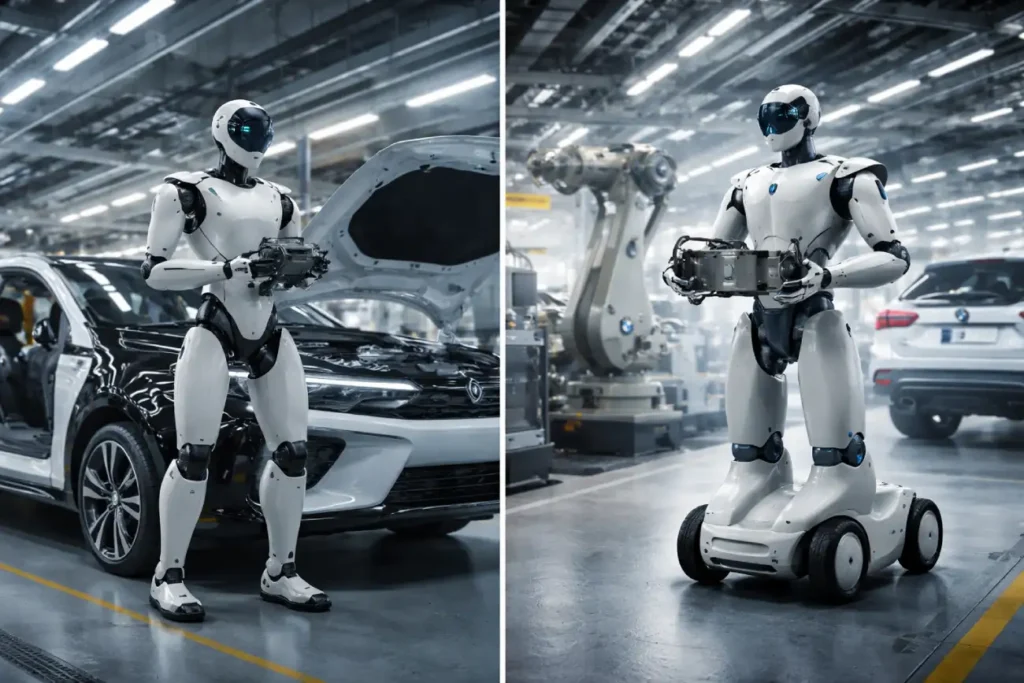
Xiaomi has focused its efforts on a single, high-tech EV plant in Beijing to perfect its “internship” model in a controlled environment. In contrast, BMW is testing across different continents, using various robot models to see how they perform in different factory cultures and climates. This tells us that Xiaomi is looking for deep integration in its own ecosystem, while BMW is looking for a broad solution that can work globally.
The mobility of the robots also differs, with Xiaomi sticking to a bipedal focus that mimics the human form as closely as possible. BMW has shown a willingness to use wheeled hybrids like AEON to prioritize speed and stability on the shop floor. This highlights a difference in philosophy: Xiaomi is building a general humanoid, while BMW is building a purpose-driven industrial tool.
Both companies measure success using different benchmarks to determine when a robot is ready for full-time work. Xiaomi looks closely at success rates in specific, high-frequency tasks like nut installation during a fixed shift. BMW focuses on the total volume of parts moved and the number of vehicles the robots contributed to over many months of operation.
The 76-Second Benchmark: The Critical Obstacle for Robotics
Doing a job correctly is only half of the challenge; doing it at the speed of an existing assembly line is the real test. If a robot cannot match the 76-second cycle of a modern plant, it becomes a liability rather than an asset. This throughput challenge is why many early prototypes failed to make it out of the lab and onto the floor.
Autonomous continuity is another major hurdle, as a robot must be able to work an entire shift without needing a human to reset it. If a machine “hallucinates” or gets stuck every thirty minutes, the cost of supervising it outweighs the benefits of the work it does. Maintaining a high success rate over hours of constant motion is a primary focus for engineers in 2026.
Scaling up from two or three interns to hundreds of robots across thousands of workstations is the final step in this process. This requires a level of reliability and ease of maintenance that is not yet fully realized in most facilities. For these machines to become full-time employees, they must be as easy to manage as any other piece of factory equipment.
Key Challenges Facing Humanoid Deployment in Manufacturing
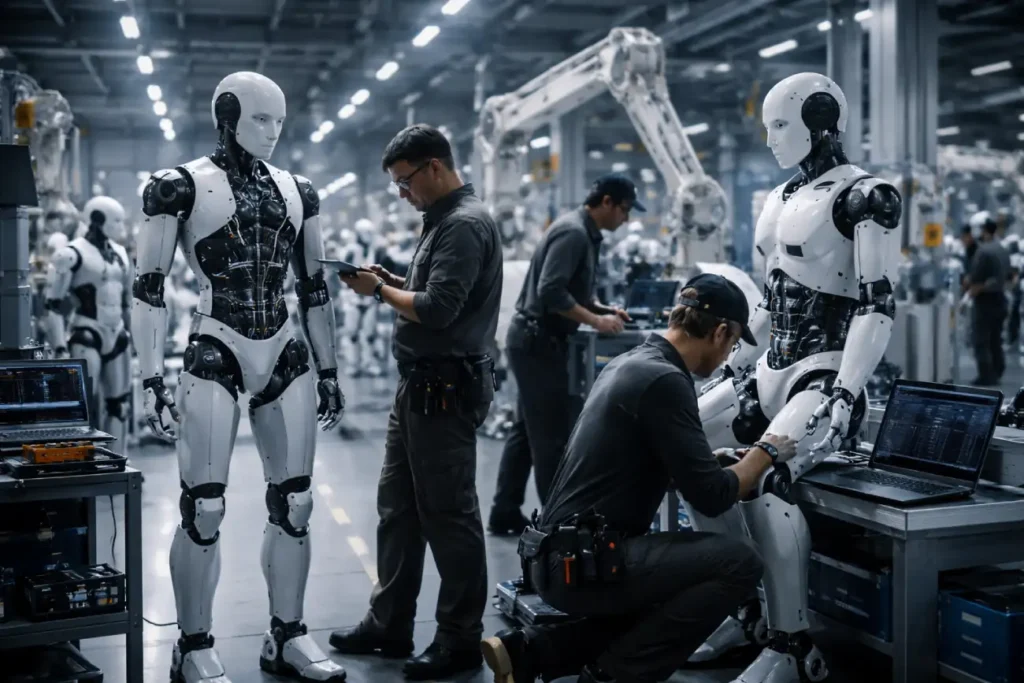
While the progress is impressive, several obstacles remain before these robots can be deployed at a massive scale. These challenges involve both the physical limits of the hardware and the complex nature of factory management.
Reliability in Continuous Autonomous Shifts
One of the main issues is hardware fatigue, where the motors and joints of a robot wear out after thousands of repetitive movements. Unlike stationary robots, humanoids have many more moving parts that can fail over time. Ensuring that a robot can run for sixteen hours a day, six days a week, requires a new level of mechanical durability.
There is also the risk of software “hallucinations” in a physical environment, where the AI misinterprets what it sees. A shadow on the floor or a change in lighting could cause the robot to pause or move in the wrong direction. Reducing these errors is critical for maintaining safety and efficiency on a fast-moving line.
As robots spend more time in the factory, engineers are gathering data on these failure points to create more robust systems. In 2026, the focus is on creating “industrial grade” humanoids that are as tough as the cars they are building. Until then, they remain in the internship phase where they can be closely monitored.
High Initial Capital Expenditure (CapEx)
The cost of a single advanced humanoid robot remains high, often reaching several hundred thousand dollars per unit. This includes not only the hardware but also the sensors, the AI models, and the specialized software needed to run them. For many manufacturers, this initial investment is a major barrier to entry.
Traditional automation, like a simple robotic arm, is often much cheaper and already proven to work. A company must be sure that a humanoid will provide more value over time before they commit to buying a fleet. This financial calculation is why we mostly see large companies like BMW and Xiaomi leading the way.
As production of these robots increases, the price is expected to drop, but for now, it is a luxury for the most advanced plants. In 2026, many firms are waiting to see the long-term return on investment before making their own purchases. The cost must eventually compete with the expense of hiring and training human workers.
Safety Protocols in Human-Shared Spaces
For a robot to be a true coworker, it must be able to move safely in the same space as humans without fences or barriers. This requires advanced collision avoidance systems that can detect a person’s presence in milliseconds. If a robot is too slow to stop, it creates a dangerous environment that no company will accept.
Safety standards for mobile humanoids are still being written and refined as more of them enter the workforce. Companies must prove that their machines can handle unpredictable human behavior, like someone running or dropping a tool. This trust is earned through thousands of hours of accident-free operation during the pilot phase.
The goal is to move away from the “caged” robots of the past and toward a more open factory floor. This requires the robots to be “cobots” that are aware of their surroundings at all times. Achieving this level of safety is a major technical achievement that is still being perfected in 2026.
Integration with Legacy Factory Software
Most modern factories run on Manufacturing Execution Systems (MES) that were built years or even decades ago. Getting a cutting-edge AI robot to communicate with these older systems is a difficult task. The robot needs to know what car is coming down the line and what parts it needs to install in real time.
If the robot cannot “talk” to the factory’s brain, it becomes an isolated island of automation that is hard to manage. This requires specialized software layers that can translate between modern AI and legacy industrial protocols. In 2026, this integration work is one of the biggest hidden costs of any robotics project.
BMW and Xiaomi are solving this by building their own digital platforms that sit between the robot and the factory. These platforms allow for better tracking of the robot’s performance and faster updates when the production plan changes. However, for smaller manufacturers, this level of custom software work may be too complex.
Maintenance and Specialized Repair Skills
When a humanoid robot breaks down, it cannot be fixed by a traditional mechanic or a standard IT technician. It requires a new class of worker who understands mechanics, electronics, and AI software all at once. There is currently a shortage of people with these specific skills, which could slow down the adoption of the technology.
Factories must invest in training their existing maintenance teams or hiring new specialists to keep the robots running. This adds another layer of cost and complexity to the deployment process. Without a reliable repair plan, a fleet of broken robots is a very expensive problem for a plant manager.
In the future, robots might be designed to help repair each other, but for now, it is a human-led task. Companies are starting to create “robot hospitals” within their plants where units are serviced and updated. This infrastructure is a necessary part of making the transition from a pilot to a permanent installation.
The Impact on the Future Manufacturing Workforce
The introduction of robots is changing the nature of work, shifting the focus from physical tasks to the management of intelligent systems. Instead of losing jobs, many workers are finding that their roles are being transformed into higher-level supervision. This means that a person who once installed nuts manually might now spend their day ensuring that a fleet of three robots is performing that same task correctly.
New roles like the “Robot Handler” are emerging in 2026, where humans act as trainers and supervisors for their robotic coworkers. These handlers are responsible for troubleshooting minor issues and teaching the AI how to handle new parts or configurations. This creates a more technical environment where workers need to understand how to interact with digital systems.
The skills gap is a real concern, and companies are responding with internal training programs to help their staff adapt. Workers are learning how to use tablets and software interfaces to direct the robots, which is a significant change from traditional manual labor. This evolution ensures that as the factory becomes more automated, the human workers remain an essential part of the process.
What’s Next: The Road to 2030
As we look toward the end of the decade, the current pilots will likely lead to large-scale rollouts involving hundreds of robots per facility. The data gathered in 2026 is the foundation for a future where humanoid machines are a common sight in every major factory. We can expect to see these “interns” move into full-time roles across entire assembly lines as their reliability increases.
Cost reduction will be a major factor in this expansion, as the mass production of humanoid hardware makes it more affordable for smaller companies. Just as the price of computers and smartphones dropped over time, the price of “Physical AI” units will eventually reach a point where most businesses can justify the investment. This will democratize the technology and move it beyond just the automotive giants.
While the automotive industry is leading the way, other sectors like logistics and aerospace are watching these pilots closely. The ability of a robot to navigate a warehouse or help assemble a plane wing would be a major advantage for those industries. The “internship” model developed by BMW and Xiaomi will likely become the blueprint for how all heavy industries adopt robotics in the future.
