

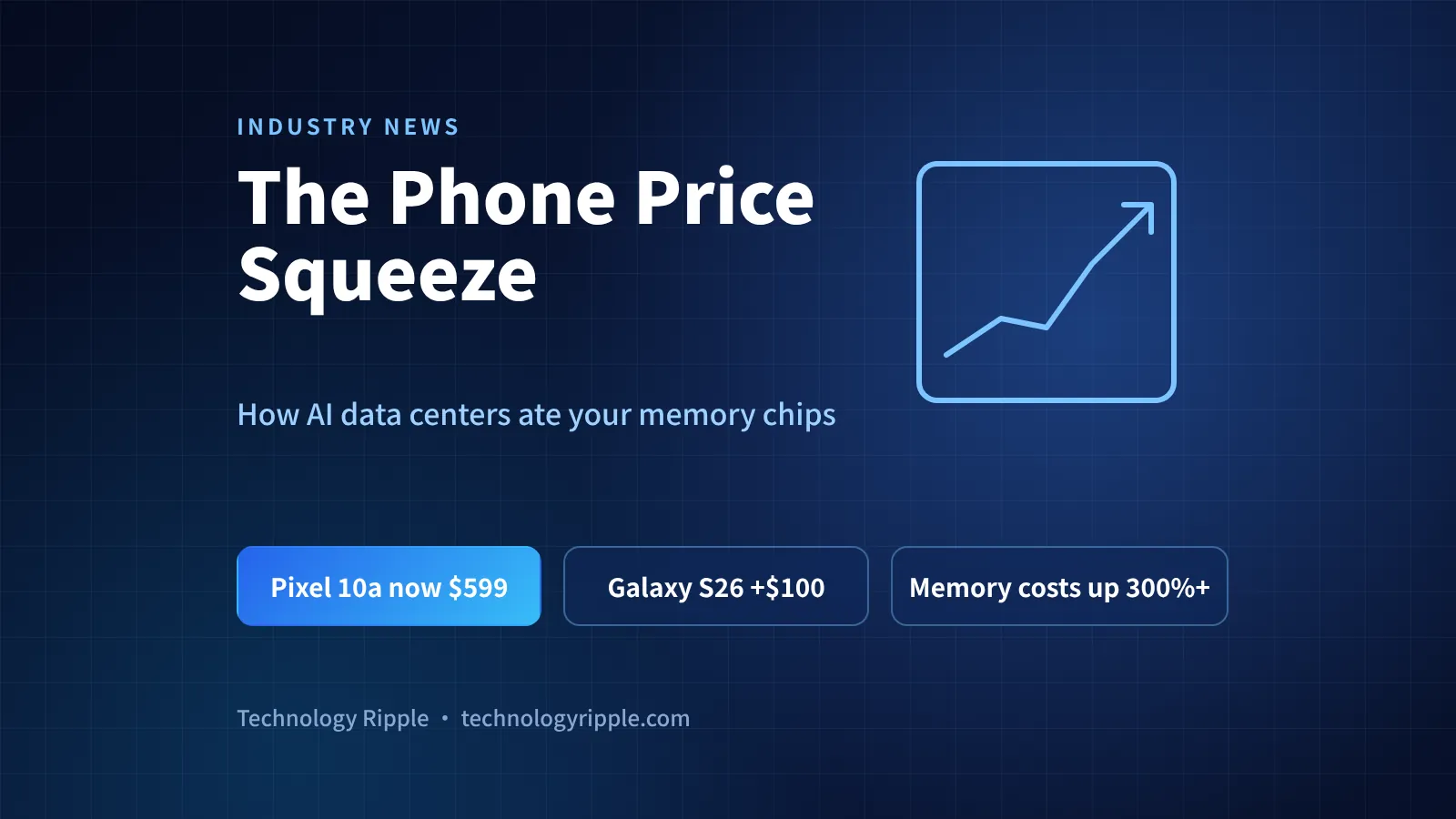
Last week, the Galaxy S26 got $100 more expensive overnight. So did the Pixel 10a, a phone that launched in March and hasn’t changed one bit since. If you’re wondering why are phone prices going up in 2026, the short answer is memory: AI data centers are buying up the world’s RAM and storage chips, and phone makers are passing the bill to you.
That’s not a guess. IDC now expects the average smartphone to sell for $581 this year, up 27.6%, while memory costs have jumped more than 300% year over year. Let’s break it down.
| Key fact | Detail |
|---|---|
| Main cause | AI data centers soaking up DRAM and NAND memory supply |
| Memory cost change | NAND and DRAM up over 300% year over year (IDC) |
| Average phone price, 2026 | $581, up 27.6% (IDC forecast) |
| Global shipments, 2026 | Down 16.7%, the steepest drop on record (IDC forecast) |
| Sub-$100 phones | Shipments down nearly 60% year over year in Q2 2026 |
| Latest US hikes | Galaxy S26 series, Galaxy A-series and Pixel 10a (October 2, 2026) |
| When it may ease | IDC expects memory prices to keep rising until at least 2028 |
Why Are Phone Prices Going Up So Fast This Year?
Here’s the thing. A phone’s price used to be mostly about the chip, the screen and the camera. Memory was a relatively cheap line item.
Not anymore. According to IDC’s August 26 forecast, NAND and DRAM costs are up more than 300% year over year, and the firm expects those prices to keep climbing until at least 2028. As a result, it now predicts global shipments will fall 16.7% to just over 1 billion units in 2026, the steepest annual decline it has ever recorded.
Counterpoint Research sees the same pressure from the retail side. Its price tracker shows global smartphone retail prices up about 15% on average in 2026, with price-sensitive markets seeing 16% to 21% increases, as reported by MacTech.
IDC’s Francisco Jeronimo, vice president for worldwide client devices, summed it up better than anyone:
“The memory tsunami that we warned about is now hitting the market in full, and consumers are starting to pay the AI bill.”
The key takeaway here is simple: you’re not imagining it, and it isn’t just one brand being greedy.
The Cause Chain, Explained Simply
So how does a chatbot in a server farm make your next phone cost more? Let’s back up a little.
Every AI data center runs on graphics processors that need a special kind of memory called high-bandwidth memory, or HBM. As Rest of World explains, HBM is built by stacking DRAM chips vertically and placing them right next to the GPU, which lets AI models chew through huge datasets quickly.
Here’s the catch. The same three companies make almost all of the world’s memory. SK Hynix, Samsung and Micron control more than 90% of global production, according to Rest of World. When AI companies order HBM in massive volumes, those manufacturers shift factory capacity away from the ordinary DRAM and NAND chips that go into phones, laptops and tablets.
That leaves this chain reaction:
- AI companies order vast amounts of HBM for data centers.
- Memory makers divert production toward HBM because that’s where demand is.
- Less regular DRAM (your phone’s RAM) and NAND (your phone’s storage) is left for consumer devices.
- Phone makers pay far more for the memory they can get.
- Those costs show up on the price tag, or as cheaper phones quietly disappearing.
How big is that jump? Google VP Shakil Barkat has said RAM costs “went from $2.80 per gigabyte to $12,” citing Morgan Stanley data, as reported by The Next Web. That’s more than a fourfold increase on a part that every phone needs.
“Your phone didn’t get more expensive because it got better. It got more expensive because AI got hungrier.”
And because building new memory capacity takes time, the squeeze doesn’t just fix itself next quarter. The key takeaway here is simple: phones are now competing with AI servers for the same chips, and servers are winning.
Phone Price Increases So Far: The Numbers
Sounds abstract? It isn’t. Here are verified US price changes from the past month.
| Phone | Old US price | New US price | Change | When |
|---|---|---|---|---|
| Galaxy S26 (256GB) | $899.99 | $999.99 | +$100 | Oct 2, 2026 |
| Galaxy S26 Plus (256GB) | $1,099.99 | $1,199.99 | +$100 | Oct 2, 2026 |
| Galaxy S26 Ultra (256GB) | $1,299.99 | $1,399.99 | +$100 | Oct 2, 2026 |
| Galaxy S26 Ultra (1TB) | $1,799.99 | $1,999.99 | +$200 | Oct 2, 2026 |
| Galaxy A17 5G | $200 | $270 | +$70 | Oct 2, 2026 |
| Galaxy A27 5G | $350 | $380 | +$30 | Oct 2, 2026 |
| Galaxy A37 5G | $450 | $490 | +$40 | Oct 2, 2026 |
| Galaxy A57 5G | $550 | $600 | +$50 | Oct 2, 2026 |
| Pixel 10a (128GB) | $499 | $599 | +$100 | Oct 2, 2026 |
| Pixel 10a (256GB) | $599 | $699 | +$100 | Oct 2, 2026 |
| iPhone 17e | $599 | $699 | +$100 | Sept 10, 2026 |
| iPhone 17 | $799 | $899 | +$100 | Sept 10, 2026 |
| iPhone Air | $999 | $1,099 | +$100 | Sept 10, 2026 |
| iPhone 16 | $699 | $799 | +$100 | Sept 10, 2026 |
Look at the Galaxy A17 5G. A $70 increase on a $200 phone is a 35% jump, which hits much harder than $100 on a $1,000 flagship. The Galaxy S26 FE was left out of Samsung’s latest round, staying at $699.99 for 128GB, according to TechRepublic.
The Apple numbers stand out for another reason. Older iPhones usually get cheaper when new models arrive. This year, Apple did the opposite and raised them by $100. If you read our iPhone 17e review, keep in mind its “budget king” pricing has since moved up to $699.
And phones aren’t alone. The same memory squeeze is why your next iPad and Mac could cost 20% more.
Who’s Getting Hit Hardest
You see, the pain isn’t spread evenly. Budget Android phones and emerging markets are taking the worst of it.
The reason is basic math. Memory makes up a much bigger share of a $100 phone’s cost than a $1,200 one, so when RAM prices quadruple, cheap phones have nowhere to hide. IDC says the sub-$100 segment, which shipped 173 million units last year, now faces an “existential crisis,” with shipments down almost 60% year over year in Q2 2026.
Rest of World’s reporting fills in the picture:
- Regional hikes: Prices rose about 21% in India, 19% across Asia-Pacific and 18% in the Middle East and Africa, compared with 5% in the US.
- Vanishing entry models: Omdia found Oppo’s sub-$100 shipments in Southeast Asia plunged 96%, while Vivo moved entry-level models above $100 in most markets.
- New price floors: Counterpoint analyst Ivan Lam told Rest of World, “What used to be below $150 may become below $250, or even $300.”
Samsung’s Indian A-series shows how it plays out on the shelf. The Galaxy A06 5G (4GB/64GB) launched at ₹10,499 and now sells for ₹14,999 after repeated hikes, according to 9to5Google.
Apple, meanwhile, is relatively insulated. IDC expects iOS shipments to dip just 1.3% this year while Android falls 24.3%. Big brands with deep pockets and long-term supply deals can absorb more of the shock.
The key takeaway here is simple: the cheaper the phone and the poorer the market, the bigger the hit.
Will Phone Prices Go Back Down?
This is the question everyone wants answered. The honest answer? Not soon.
IDC expects memory prices to keep rising until at least 2028. Even after that, 9to5Google’s read of the IDC report says average selling prices are expected to fall only 1% to 2% a year. IDC put it bluntly: “The cheap smartphone era is not pausing. It is over.”
Other forecasts vary. Engadget notes that relief could take about a year in an optimistic scenario, or stretch through 2030 in a pessimistic one. Counterpoint senior analyst Karn Chauhan also expects new phone prices to keep rising over the coming quarters, including for the iPhone 18 series.
That said, nobody can predict exactly when new memory factories will catch up with AI demand. Treat any confident “prices drop next year” claim with suspicion.
The key takeaway here is simple: plan as if today’s prices are the new normal for the next couple of years.
How to Buy a Phone Without Overpaying Right Now
Prices are rising, but you still have options. Here’s how to stretch your budget.
1. Buy before the next round of hikes
Samsung’s Indian budget phones have been repriced five times in recent months, according to 9to5Google. If you’ve already settled on a model and your current phone is failing, waiting rarely pays off right now. Sales events help too, so check our roundup of Prime Big Deal Days 2026 tech deals before you check out.
2. Go refurbished from a reputable seller
Counterpoint notes that consumers are already turning to refurbished devices to cope. Stick with manufacturer-certified or well-reviewed resellers that offer a warranty and a decent return window. You’ll get a newer phone for less, and you skip the memory premium baked into new stock.
3. Squeeze every dollar out of your trade-in
Trade-in credits are one of the few ways to offset a $100 hike directly. Compare carrier, manufacturer and third-party offers, since they can differ a lot for the same phone. Wipe your device and keep it in good shape to avoid deductions.
4. Look at last year’s flagship instead of this year’s budget phone
When a $200 phone jumps to $270, a discounted older flagship can suddenly look like better value. Just check how many years of software updates it has left. If you want something newer on Android, compare options like the OnePlus 16 against the repriced Galaxy and Pixel lineups.
5. Keep your current phone longer
The cheapest phone is the one you already own. A new battery or a screen repair costs far less than a replacement, and it buys you time until prices settle. Counterpoint says many buyers are already delaying upgrades for exactly this reason.
6. Don’t pay for storage you won’t use
Memory is the expensive part now, and storage tiers show it. The 1TB Galaxy S26 Ultra jumped $200 while the 256GB model rose $100. If cloud storage covers your photos, the base tier is the smarter buy.
Looking Ahead: Smarter Buying in a Pricier Era
The memory crunch is a strange side effect of the AI boom. The same technology that’s supposed to make your phone smarter is making it more expensive to buy.
But you’re not powerless. Knowing why prices are climbing helps you time your purchase, choose the right storage tier and consider refurbished or older models without feeling like you’re settling. Prices may not fall for a while, so the best move is a well-informed one. Keep an eye on new launches, watch for sales and hold on to that trusty phone a little longer if it still does the job.
Frequently Asked Questions
It’s unlikely. IDC expects memory prices to keep rising until at least 2028, and Counterpoint expects new phone prices to keep climbing over the coming quarters.
Eventually, but slowly. 9to5Google’s summary of IDC’s outlook says average prices may drop only 1% to 2% a year once memory supply stabilizes around 2028.
Memory makers are shifting production toward high-bandwidth memory for AI data centers. That leaves less ordinary RAM and storage for phones, so phone makers pay more and pass the cost to you.
Apple raised the iPhone 16, iPhone 17e, iPhone 17 and iPhone Air by $100 each in September 2026, according to TechRepublic, which tied the increases to rising memory costs. It’s unusual, since older models normally get cheaper after a new launch.
Budget Android phones, especially in emerging markets. IDC reports sub-$100 phone shipments fell nearly 60% year over year in Q2 2026, and prices in India rose about 21%, per Rest of World.
Avoid financing a pricier phone you don’t need, use trade-in credit to cut the upfront cost and review your plan for unused data or extras. Keeping your current phone longer also stops a new device payment from landing on your bill.
